Shopify vs WooCommerce for Indian Businesses in 2026 — Which One to Choose
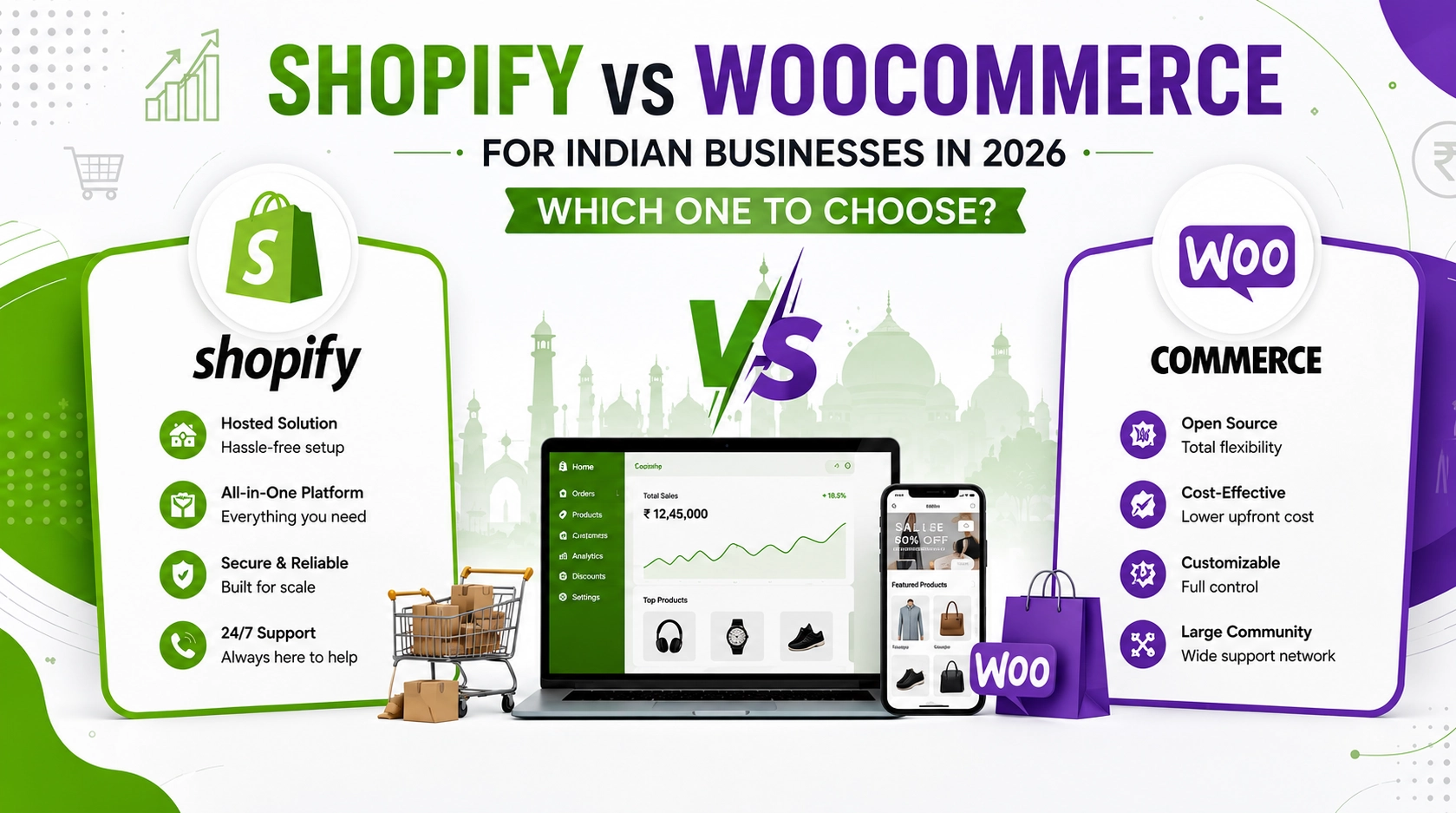
The eCommerce market in India continues to grow at a remarkable pace. Businesses across industries ranging from local retailers and manufacturers to D2C brands and service providers are investing in online stores to reach customers beyond geographical boundaries.
One of the first choices that business owners should make is to choose the right eCommerce platform. Shopify and WooCommerce are still two of the most popular choices in 2026.
Although both platforms can help businesses sell online, they are very different in terms of setup, flexibility, maintenance, scalability, and long-term costs. It is important to know these differences before you spend time and resources on building an online store.
Why Your eCommerce Platform Matters
An eCommerce platform is more than just a website builder. It affects:
- Website Performance– A fast and reliable platform allows pages to load quickly, which enhances user satisfaction and conversions.
- Customer Experience – Easy navigation, responsive design, and smooth checkout create a better shopping experience for customers.
- Search Engine Visibility – SEO-friendly features Get more traffic to your store and higher rankings in search results.
- Payment Processing – Secure and flexible payment options make it easier for customers and businesses to transact.
- Security – Customer data, payment details, and business operations are protected by built-in security measures.
- Scalability – The platform should be able to manage a growing business, traffic, and product catalogs without any performance issues.
- Day-to-Day Management – User-friendly tools make it simple to manage your inventory, process orders, update content, and maintain your store.
Choosing the wrong platform may lead to extra costs, technical limits and migration challenges into the future.
Shopify: Built for Simplicity and Growth
Shopify is a fully hosted eCommerce platform that makes selling online easier. Business owners don’t have to worry about web hosting, software updates, security patches or server management.
This makes Shopify especially attractive for startups and businesses who want to focus on selling rather than the technical administration.
For example – A clothing brand launching its first online store can start selling in just a few of days, without the necessity of hiring a dedicated developer.
WooCommerce: Built for Flexibility and Control
WooCommerce functions in a different way. Built on WordPress, it is an open-source eCommerce solution that gives companies total control and ownership over their websites.
WooCommerce, in contrast to Shopify, permits extensive customization of each aspect of the online business, including client journeys, product displays, and checkout processes.
Businesses with special operating needs or requests for specialized functionality frequently find this flexibility appealing.
Comparing Shopify and WooCommerce for Indian Businesses
| Feature | Shopify | WooCommerce |
|---|---|---|
| Setup | Quick and beginner-friendly | Requires WordPress setup |
| Hosting | Included | Separate hosting needed |
| Cost | Fixed monthly plans | Flexible, depends on hosting and plugins |
| Customization | Easy with apps | Highly customizable |
| SEO | Strong built-in SEO tools | Advanced SEO control |
| Performance | Managed and optimized | Depends on hosting quality |
| Security | Handled by platform | User-managed |
| Maintenance | Minimal effort | Regular updates required |
| Scalability | Suitable for growing stores | Scales with proper optimization |
| Best For | Businesses wanting simplicity | Businesses needing flexibility |
Setup and Ease of Use
Shopify offers a simple setup process for entrepreneurs with limited technical expertise. The majority of key features are accessible as soon as an account is created.
WooCommerce requires additional steps, including purchasing hosting, configuring WordPress, installing plugins, and managing updates.
Shopify provides a more straightforward beginning point for many entrepreneurs, but companies with internal technological teams might not see this as a problem.
Cost Considerations
The two platforms’ cost structures are very different from one another.
Shopify’s monthly costs are predictable due to its subscription-based business strategy.
While WooCommerce is free in and of itself, the entire investment should take into account related expenses like hosting, premium plugins, security tools, and maintenance.
Businesses should evaluate both short-term and long-term expenses rather than focusing solely on initial costs.
SEO and Organic Growth
Search engine visibility plays a crucial role in eCommerce success.
Shopify includes many built-in SEO features that help businesses optimize product pages and collections.
WooCommerce is especially appealing to companies that significantly spend in content marketing, blogging, and long-form SEO methods because it provides more flexibility through WordPress.
WooCommerce may offer extra benefits to businesses who intend to create significant traffic through educational content and organic search.
Scalability and Future Growth
Platform scalability becomes more crucial as order quantities increase.
Shopify’s infrastructure is built to manage increasing transaction volumes and traffic spikes without requiring store owners to engage in a lot of technical work.
WooCommerce may also scale well, but maintaining optimum performance often requires the need for stronger hosting options and continuous optimization work.
Whether a company wants more technical control or a managed solution will determine the best option.
Indian Business Use Cases
The right platform often depends on the kind of business you run and your long-term objectives. Both Shopify and WooCommerce can support successful online stores, each platform is better suited for different business types.
Shopify Works Well For
- D2C Brands: Shopify’s quick checkout process, scalability, and ease of setup are advantages for companies who sell directly to customers.
- Fashion and Apparel Stores: With minimal technical effort, clothing, footwear, and lifestyle brands may quickly build visually appealing online stores.
- Beauty and Cosmetic Brands: Shopify development is perfect for businesses in the beauty and skincare businesses because of its streamlined store management and app integrations.
- Startups and Small Businesses: Entrepreneurs that wish to get into the eCommerce business quickly may launch and run their stores without a high level of technical expertise.
- High-Growth Businesses: Shopify’s infrastructure can be used by businesses expecting quick expansion to manage higher traffic and sales volumes.
WooCommerce Works Well For
- Manufacturing Businesses: Manufacturers selling products online can customize their stores to support complex product catalogs and customer requirements.
- Wholesale and B2B Businesses: WooCommerce allows businesses to create custom pricing structures, quotation systems, and account-based purchasing experiences.
- Content-Making Brands: Businesses that depend on blogging, educational material, and organic search traffic might benefit from WordPress’s powerful content management features.
- Niche eCommerce Stores: WooCommerce’s wide range of customisation capabilities frequently help businesses with customized products or unique customer journeys.
- Businesses Requiring Full Control: WooCommerce development is frequently preferred by businesses who desire complete authority over their website, hosting environment, and functionality.
Which Platform Is Right for Your Business?
Since every business functions differently, there is no universal answer.
Shopify is frequently appropriate for companies looking for a platform that requires minimal technical expertise, a speedy launch, and easier maintenance.
WooCommerce is often preferred by businesses that need full control over their website structure, content-driven strategies for marketing, and advanced personalization.
Instead of depending solely on platform popularity, the selection should take consider of future growth plans, business objectives, and available resources.
Final Thoughts
Choosing between Shopify and WooCommerce is not simply a technology decision — it is a business decision that will shape how you operate, grow, and serve your customers online.
Shopify suits businesses that want a reliable, low-maintenance platform that lets them focus entirely on sales and growth. WooCommerce suits businesses that need deeper control, content-led marketing, or highly customized customer experiences.
Neither platform is universally better. What matters is how well the platform fits your business model, your team’s capabilities, and your growth plans for the next few years.
Before committing, ask yourself a few practical questions. How quickly do you need to launch? Do you have technical resources in-house? How important is content and SEO to your long-term strategy? What does your budget look like — not just today, but over the next two to three years?
The answers to these questions will point you toward the right choice far more reliably than any feature comparison.
If you are still uncertain, speaking with an experienced eCommerce consultant can help you avoid costly mistakes and build on a foundation that genuinely supports where your business is headed.
People Also Ask
1. Which is better for beginners, Shopify or WooCommerce?
Shopify is generally better for beginners because it offers hosting, security, and store management in one platform. WooCommerce requires WordPress setup and more technical involvement.
2. Which platform is better for SEO: Shopify or WooCommerce?
WooCommerce offers greater SEO flexibility through WordPress plugins and customization options. Shopify provides strong built-in SEO features but has fewer advanced customization options.
3. Is Shopify suitable for large eCommerce stores?
Yes, Shopify is designed to scale and can handle high traffic volumes, large product catalogs, and enterprise-level businesses through advanced plans.
4. Can I migrate from WooCommerce to Shopify later?
Yes, several migration tools and services allow businesses to transfer products, customers, and order data from WooCommerce to Shopify with minimal disruption.
5. Is Shopify worth the monthly subscription cost?
For many businesses, Shopify’s subscription fee is justified by its ease of use, built-in features, security management, and dedicated support.
6. Can WooCommerce Handle 10,000 Products?
Yes, WooCommerce can efficiently handle 10,000 or more products when supported by quality hosting, proper optimization, and performance-focused plugins. Many medium and large online stores use WooCommerce to manage extensive product catalogs.
7. Which Platform Is Easier to Maintain?
Shopify is generally easier to maintain because hosting, security updates, backups, and platform maintenance are managed by Shopify. Store owners can focus on running their business without worrying about technical tasks.

About The Author
Akshita Dubey is an SEO Executive at eWebWorld with expertise in search intent analysis and content optimization. She focuses on creating user-centric content that simplifies complex technology topics, helping businesses and decision-makers understand web development, mobile apps, and digital solutions through clear, research-based insights.
Search
Popular Posts

Follow us

Recent Posts

About eWebWorld
eWebWorld is a Shopify and eCommerce development company in India with 10+ years of experience building and scaling online stores. We specialize in Shopify development, including store setup, customizations, theme development, migrations, integrations, and performance optimization. Through our expertise in eCommerce, technology, and digital marketing, we help businesses create better online experiences and achieve sustainable growth.