
Can AI Build a Mobile App? What You Should Know Before Trying
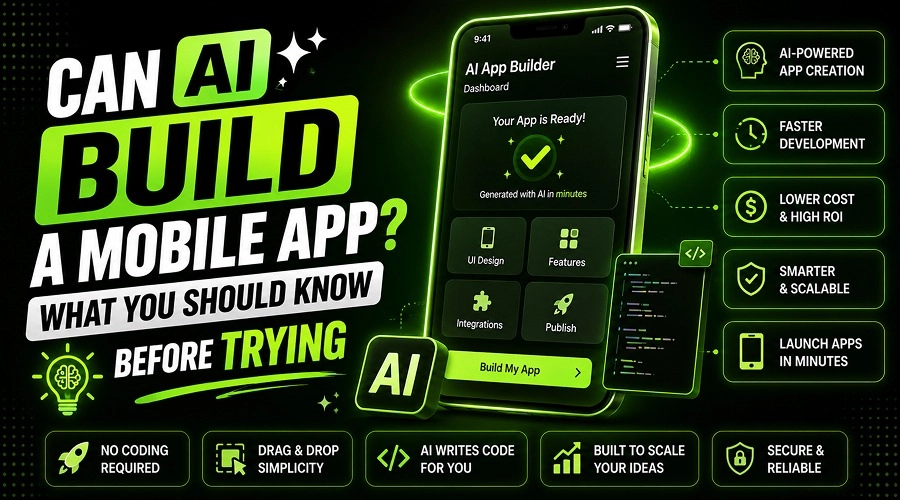
Mobile app development is evolving rapidly, and AI is becoming a major part of that transformation. Today, businesses and startups are constantly seeing tools that promise to build mobile apps in minutes using artificial intelligence. AI-powered app builders are making app development feel faster and more accessible than ever before, from generating app layouts to writing code automatically.
But while AI can simplify parts of the process, building a successful mobile app is still far more complex than simply generating a few screens and publishing them online.
There’s a major difference between creating a basic app prototype and developing a secure, scalable, and high-performing mobile application that users genuinely enjoy using. Factors like user experience, performance optimization, integrations, security, and long-term scalability still require strategic thinking and technical expertise.
So, can AI really build a mobile app?
The answer is yes, to a certain extent. AI can help accelerate development, generate ideas, create interfaces, and even build functional prototypes. However, there are still important limitations businesses should understand before depending entirely on AI-generated development.
In this blog, we’ll explore what AI app builders can realistically do, where they still struggle, and when businesses should consider combining AI tools with professional development expertise.
What AI App Builders Can Actually Do
AI-powered app development tools have evolved rapidly in recent years. Today, businesses can use AI to speed up several parts of the mobile app development process, from generating layouts and writing code to building prototypes and automating repetitive tasks. While these tools are impressive, their capabilities are strongest during the early stages of development and for simpler applications.
1. Creating Basic App Layouts and UI Designs
AI tools can quickly generate mobile app screens, layouts, and interface suggestions based on user prompts. This helps businesses visualize app ideas faster without starting from scratch. AI app builders can help with:
- UI layout generation
- screen structuring
- design suggestions
- drag-and-drop app building
- rapid interface prototyping
Popular platforms:
2. Building MVPs and Prototypes Faster
One of AI’s biggest advantages in app development is speed. Businesses and startups can create MVPs (Minimum Viable Products) much faster to test ideas and gather early feedback. AI tools are commonly used for:
- startup idea validation
- proof-of-concept apps
- internal business tools
- quick product demos
- early-stage testing
Popular platforms:
3. Generating Code and Automating Tasks
AI coding assistants can generate code snippets, automate repetitive tasks, and help developers work more efficiently. This can significantly reduce development time for certain workflows.
AI tools can assist with:
- code generation
- workflow automation
- API integrations
- database setup
- debugging suggestions
Popular platforms:
4. Helping Non-Technical Users Build Simple Apps
AI and no-code platforms have made app development more accessible for users with limited technical knowledge. Small businesses and entrepreneurs can now create simple applications without hiring a full development team immediately.
These tools are commonly used for:
- basic business apps
- booking systems
- inventory management
- internal company tools
- event or community apps
Popular platforms:
Where AI Still Struggles
While AI app builders have become more advanced, they still have important limitations. Creating a basic app is very different from building a reliable, scalable, and business-ready mobile application.
This is where human expertise still plays a major role in mobile app development.
1. Handling Complex App Logic
AI tools work best with simple workflows and standard app structures. However, when apps require advanced features, custom systems, or unique business logic, AI-generated development can quickly become difficult to manage. AI often struggles with:
- complex workflows
- custom backend systems
- advanced user permissions
- real-time processing
- large-scale application architecture
For businesses building feature-rich applications, custom development is usually still necessary.
2. Security and Data Protection
Security is one of the biggest concerns with AI-generated applications. Apps that handle sensitive customer information require proper security practices, testing, and compliance measures. This becomes especially important for apps involving:
- online payments
- personal user data
- healthcare information
- financial transactions
- account authentication systems
While AI can generate functional code, it may not always follow best security practices consistently.
3. Performance and Scalability
Many AI-generated apps work well during the prototype stage but struggle as user traffic and app complexity increase.
Performance issues may include:
- slower loading times
- inefficient code structure
- poor database optimization
- limited scalability
- app crashes under heavy usage
A prototype may work for a small audience, but scaling it into a production-ready app often requires experienced developers and proper architecture planning.
4. User Experience and Strategic Design
AI can generate app screens quickly, but good user experience goes beyond visual layouts. Successful mobile apps are designed around user behavior, business goals, and long-term engagement. AI still has limitations when it comes to:
- understanding customer psychology
- designing intuitive user journeys
- creating brand-focused experiences
- improving engagement strategies
- balancing functionality with usability
This is why human designers and developers remain essential in creating apps that feel polished and user-friendly.
5. Long-Term Maintenance and Flexibility
Apps continue evolving after launch. Businesses often need updates, feature expansions, third-party integrations, and ongoing maintenance over time. AI-generated apps can become difficult to maintain when:
- business requirements change
- custom integrations are needed
- platforms update their policies
- new features are added
- the app grows in complexity
In many cases, businesses eventually require experienced development teams to properly scale and maintain the application.
AI can absolutely accelerate parts of mobile app development. However, businesses should view AI as a tool that supports development, not as a complete replacement for strategy, design, and technical expertise.
AI App Builders vs Traditional Mobile App Development
AI-powered app builders have made mobile app development faster and more accessible, especially for startups and small businesses. However, traditional development still offers advantages when businesses need flexibility, scalability, and long-term reliability.
The right choice often depends on the complexity of the app, business goals, budget, and future growth plans.
| Feature | AI App Builders | Traditional App Development |
|---|---|---|
| Development Speed | Faster setup and quicker prototyping | Longer development timeline |
| Initial Cost | Lower upfront cost | Higher initial investment |
| Best Use Cases | MVPs, simple apps, internal tools | Complex and scalable applications |
| Customization | Limited flexibility | Full customization and control |
| Coding Knowledge | Minimal technical knowledge required | Requires experienced developers |
| Scalability | Can become difficult to scale | Better suited for long-term growth |
| Performance Optimization | Basic optimization capabilities | Advanced performance optimization |
| User Experience | Template and AI-generated experiences | Fully customized UX and UI design |
| Maintenance | Limited flexibility for future updates | Easier long-term maintenance and expansion |
| Integrations | Basic third-party integrations | Advanced and custom integrations |
| Ownership & Control | Platform limitations may apply | Full ownership of the application |
The Future of Mobile App Development: AI and Developers Working Together
AI is undoubtedly changing the way mobile apps are built. From faster prototyping to automated coding assistance, AI-powered tools are helping businesses and developers accelerate parts of the development process like never before.
However, the future of mobile app development is unlikely to be about AI replacing developers entirely. Instead, the industry is moving toward a more practical and powerful approach: AI helping developers work faster, smarter, and more efficiently.
AI can assist with:
- generating code snippets
- speeding up repetitive tasks
- creating prototypes quickly
- improving development workflows
- reducing manual effort during early-stage development
At the same time, experienced developers still play a critical role in:
- application architecture
- scalability planning
- security implementation
- custom feature development
- user experience strategy
- long-term maintenance and optimization
In many ways, AI is becoming a development assistant rather than a complete replacement for human expertise.
Businesses that combine AI-powered tools with experienced development teams can often achieve the best results like faster development timelines without sacrificing quality, scalability, or performance.
As AI technology continues evolving, mobile app development will likely become more efficient and accessible. But successful apps will still depend on strategic thinking, creative problem-solving, and human understanding of real user needs.
Conclusion
AI has made mobile app development faster, more accessible, and more efficient than ever before. Businesses can now use AI-powered tools to generate app layouts, build prototypes, automate coding tasks, and validate ideas much more quickly than traditional development methods alone. For startups, small businesses, and early-stage products, AI app builders can be an excellent way to speed up development and reduce initial costs.
However, building a successful mobile app still involves much more than generating screens or writing basic code. Factors like scalability, security, performance, customization, and user experience continue to require strategic planning and experienced development expertise.
AI can help build apps faster, but creating a reliable, scalable, and high-performing product still depends heavily on human decision-making and technical knowledge.
For businesses looking to build modern mobile applications, partnering with experienced teams like eWebWorld can help ensure that AI is used as a powerful tool within a strong development strategy, not as a shortcut that compromises long-term success.
People Also Ask
1. Can You Actually Build an App With AI?
Yes, AI can help build mobile apps by generating layouts, writing code snippets, creating workflows, and speeding up parts of the development process. AI app builders and no-code platforms can even help users create basic applications without advanced coding knowledge. However, complex apps still often require experienced developers for scalability, security, customization, and long-term maintenance.
2. What to Know Before Building an App?
Before building a mobile app, businesses should clearly define their goals, target audience, required features, budget, and long-term scalability needs. It’s also important to decide whether a simple AI-generated app is enough or if custom development is needed for advanced functionality, security, and future growth.
3. Is It Legal to Use AI to Build an App?
Yes, using AI tools for app development is generally legal. However, businesses should still review licensing terms, intellectual property considerations, and data privacy requirements. AI-generated code may also require human review to ensure compliance with platform guidelines, security standards, and legal regulations.
4. What AI Can Build Mobile Apps?
Several AI-powered and no-code platforms can help build mobile apps, including:
These platforms are commonly used for MVPs, prototypes, internal tools, and simpler business applications.
5.What Should You Know Before Building a Mobile App?
Before developing a mobile app, businesses should understand that successful apps require more than just attractive design or generated code. Performance, user experience, scalability, security, integrations, and ongoing maintenance all play a major role in long-term success. Choosing the right development approach early can help avoid costly changes later.
6. What Is the Difference Between AI App Builders and Custom App Development?
- AI app builders focus on speed, accessibility, and rapid prototyping, making them useful for simple apps and early-stage projects.
- Custom app development, on the other hand, offers greater flexibility, advanced functionality, scalability, stronger security, and complete control over the application. Businesses with complex requirements often benefit more from custom development solutions.
7. Can AI Help Speed Up App Development?
Yes, AI can significantly speed up app development by automating repetitive tasks, generating code suggestions, creating prototypes, and simplifying workflows. Many developers now use AI tools to improve efficiency and reduce development time. However, human expertise is still essential for strategy, architecture, testing, and optimization.

About The Author
Akshita Dubey is an SEO Executive at eWebWorld with expertise in search intent analysis and content optimization. She focuses on creating user-centric content that simplifies complex technology topics, helping businesses and decision-makers understand web development, mobile apps, and digital solutions through clear, research-based insights.
Search
Popular Posts





Follow us

Recent Posts

About eWebWorld
eWebWorld is a Shopify and eCommerce development company in India with 10+ years of experience building and scaling online stores. We specialize in Shopify development, including store setup, customizations, theme development, migrations, integrations, and performance optimization. Through our expertise in eCommerce, technology, and digital marketing, we help businesses create better online experiences and achieve sustainable growth.