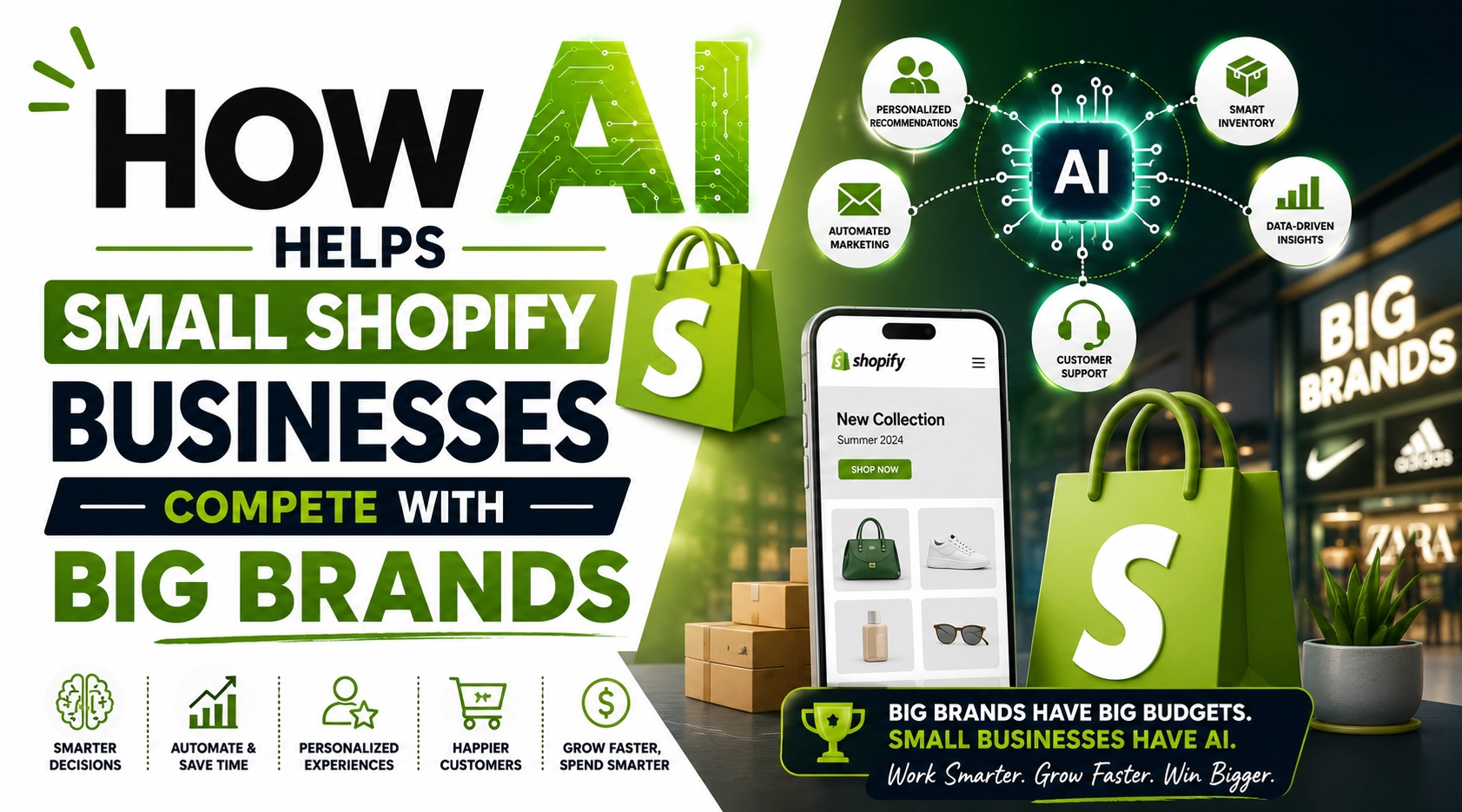
How AI Helps Small Shopify Businesses Compete with Big Brands
A decade ago, competing with established eCommerce giants seemed almost impossible for small Shopify businesses. Big brands had larger marketing budgets, dedicated customer support teams, advanced analytics, and the resources to deliver highly personalized shopping experiences. Small businesses, on the other hand, often relied on manual processes, limited staff, and intuition to make business decisions.
Fast forward to today, and the landscape has changed dramatically.
Artificial Intelligence (AI) has become one of the biggest equalizers in eCommerce. Tasks that once required entire departments—such as customer segmentation, personalized recommendations, inventory forecasting, and marketing optimization—can now be automated using AI-powered Shopify tools. What was once exclusive to enterprise retailers is now accessible to startups and growing online stores at an affordable cost.
This doesn’t mean AI replaces business owners or guarantees overnight success. Instead, it gives small Shopify stores the ability to work smarter, respond faster to customer needs, and make informed decisions using real-time data. When implemented strategically, AI helps businesses improve customer experiences, streamline operations, and compete more effectively with larger competitors.
In this guide, we’ll explore how AI is reshaping the Shopify ecosystem, the practical ways small businesses can leverage it, and why adopting AI is becoming a competitive necessity rather than just another technology trend.
Why Small Shopify Businesses Have Traditionally Struggled Against Big Brands
To understand AI’s impact, it’s important to first understand the challenges that smaller Shopify stores face.
Large retailers benefit from significant operational advantages. They have dedicated teams managing marketing campaigns, analyzing customer data, optimizing product listings, handling customer service, and forecasting inventory. These resources allow them to respond quickly to market trends and deliver consistent shopping experiences across multiple channels.
For many small Shopify businesses, however, one person may be responsible for everything—from managing inventory and fulfilling orders to creating social media content and answering customer queries.
Some of the most common challenges include:
- Limited marketing budgets compared to enterprise competitors.
- Difficulty analyzing large volumes of customer data.
- Time-consuming manual tasks like writing product descriptions and updating inventory.
- Limited ability to provide personalized shopping experiences.
- Challenges in scaling customer support during peak shopping seasons.
As customer expectations continue to evolve, these limitations become even more apparent. Today’s online shoppers expect personalized recommendations, instant responses, accurate product information, and seamless shopping experiences—regardless of whether they’re buying from a multinational retailer or a small Shopify store.
This is where AI changes the game.
AI Is Leveling the Playing Field
Think of AI as a highly efficient digital assistant rather than a replacement for human expertise.
Instead of hiring multiple specialists, small businesses can use AI to automate repetitive tasks, uncover valuable customer insights, and make smarter decisions based on data. This allows business owners to focus on areas where human creativity and strategic thinking matter most, such as branding, product development, and customer relationships.
For example, AI can help a Shopify merchant:
- Recommend products based on browsing history.
- Predict which products are likely to sell during seasonal campaigns.
- Generate first drafts of SEO-friendly product descriptions.
- Respond instantly to common customer inquiries.
- Identify customers who are likely to make repeat purchases.
- Suggest marketing campaigns based on customer behavior.
These capabilities enable smaller businesses to offer shopping experiences that rival those of much larger brands—without requiring enterprise-level budgets.
Expert Insight: AI doesn’t give small businesses an unfair advantage over large retailers. Instead, it removes many of the operational disadvantages that previously prevented them from competing on customer experience and efficiency.
1. AI Helps Small Shopify Stores Deliver Personalized Shopping Experiences
One of the biggest reasons customers return to major online retailers is personalization.
When shoppers visit large eCommerce platforms, they often see product recommendations tailored to their interests, recently viewed items, and previous purchases. These personalized experiences encourage customers to spend more time browsing and increase the likelihood of additional purchases.
Previously, creating this level of personalization required sophisticated data analysis and custom-built recommendation engines. Today, AI-powered Shopify apps make these capabilities accessible to businesses of any size.
How AI Personalization Works
AI continuously analyzes customer interactions, including:
- Products viewed
- Search queries
- Purchase history
- Cart additions
- Browsing behavior
- Customer preferences
Using this information, AI predicts which products a shopper is most likely to purchase next.
Example Scenario
Imagine you own a Shopify store that sells fitness equipment.
A customer purchases a yoga mat.
Instead of displaying random products after checkout, AI recognizes common purchasing patterns and recommends complementary items such as:
- Resistance bands
- Yoga blocks
- Foam rollers
- Reusable water bottles
These recommendations feel relevant rather than intrusive because they’re based on actual customer behavior instead of guesswork.
Why This Matters
Personalized shopping experiences can help businesses:
- Increase average order value (AOV)
- Improve conversion rates
- Reduce product discovery time
- Encourage repeat purchases
- Build stronger customer loyalty
For small Shopify businesses, personalization is no longer a luxury—it’s becoming an expectation. AI makes it possible to deliver these experiences without investing in expensive enterprise software or building complex recommendation systems from scratch.
Ready to make your Shopify store smarter with AI?
From AI-powered automation and personalized shopping experiences to advanced Shopify development solutions, our team helps businesses build faster, smarter, and more competitive online stores.
Explore AI-powered Shopify solutions and take your eCommerce growth to the next level.
2. AI Makes Customer Support Available 24/7 Without Growing Your Team
Customer expectations have changed significantly over the past few years. Most shoppers no longer want to wait several hours—or even a full day—for answers to simple questions. Whether they’re asking about shipping times, return policies, product availability, or order status, they expect quick and accurate responses.
For large eCommerce brands, meeting these expectations is relatively straightforward because they often have dedicated customer support teams working across multiple shifts. Small Shopify businesses, however, rarely have the resources to provide round-the-clock assistance.
This is where AI-powered customer support becomes a practical advantage.
Modern AI chatbots can instantly handle routine customer queries without requiring constant human intervention. They can answer frequently asked questions, guide shoppers to relevant products, assist with order tracking, explain return policies, and even escalate more complex issues to a human representative when necessary.
What AI Can Handle Automatically
- Shipping and delivery questions
- Order tracking requests
- Product availability
- Return and refund policies
- Frequently asked questions
- Basic product recommendations
By automating repetitive conversations, business owners spend less time answering the same questions and more time focusing on growth, marketing, and customer relationships.
A Better Experience for Customers
Fast responses improve the overall shopping experience. Customers are more likely to complete a purchase when they receive immediate assistance instead of waiting for an email reply the next business day.
For small Shopify stores, AI customer support isn’t about replacing human interaction—it’s about ensuring customers receive timely help while allowing business owners to use their time more effectively.
3. AI Helps Small Businesses Create Smarter Marketing Campaigns
Marketing is one of the biggest areas where large brands traditionally had an advantage. They could invest thousands of dollars into customer research, advertising experiments, and data analysis to understand what works.
Small Shopify businesses often struggle because they have limited budgets and fewer resources to test different strategies.
AI is changing this by making advanced marketing capabilities accessible to smaller businesses.
AI-powered marketing tools can analyze customer behavior, identify buying patterns, and help businesses create more targeted campaigns. Instead of showing the same advertisement to everyone, businesses can use AI to deliver more relevant messages to different customer groups.
How AI Improves Shopify Marketing
AI can help with:
- Audience segmentation
- Email personalization
- Ad optimization
- Customer behavior analysis
- Content recommendations
- Campaign performance prediction
Example:
A Shopify clothing store may have different types of customers:
- First-time visitors
- Repeat buyers
- Customers who abandoned their carts
- Customers who haven’t purchased in months
Instead of sending the same promotional email to everyone, AI can create targeted campaigns:
New visitors:
“Explore our best-selling collection.”
Abandoned cart customers:
“Still thinking about your favorite product? Complete your purchase today.”
Existing customers:
“New arrivals based on your previous purchases.”
This level of personalization helps small businesses compete with the marketing experience customers usually associate with large brands.
4. AI Helps Shopify Stores Improve SEO and Content Marketing
For small eCommerce businesses, organic search traffic is one of the most valuable growth channels. Ranking on Google allows businesses to attract potential customers without continuously spending money on advertisements.
However, creating optimized content at scale can be challenging.
AI helps Shopify businesses improve their SEO efforts by assisting with:
- Keyword research
- Product description optimization
- Blog topic generation
- Content outlines
- Meta titles and descriptions
- Internal linking suggestions
- Search intent analysis
For example, instead of writing a generic product description:
“Premium cotton t-shirt available in multiple colors.”
AI can help create more customer-focused content:
“Designed with breathable premium cotton fabric, this lightweight t-shirt keeps you comfortable throughout the day. Perfect for casual outings, workouts, and everyday wear.”
The second description focuses on customer benefits while naturally including relevant search terms.
Important Note:
AI should support SEO strategies, not replace human expertise.
Google and AI-powered search systems prioritize helpful, accurate, experience-based content. Businesses should review AI-generated content, add real product knowledge, include customer insights, and maintain their unique brand voice.
When combined with proper SEO practices, AI can help small Shopify stores create better content faster.
5. AI Makes Inventory Management More Accurate
Inventory management is one of the biggest challenges for growing eCommerce businesses.
Having too much inventory increases storage costs, while running out of popular products results in lost sales and disappointed customers.
Large brands solve this problem using advanced forecasting systems, but AI is making similar capabilities available to smaller Shopify merchants.
AI-powered inventory tools analyze:
- Previous sales data
- Seasonal trends
- Customer demand patterns
- Product performance
- Market changes
Using this information, AI can help predict:
- Which products are likely to sell more
- When inventory needs to be restocked
- Which products are underperforming
- How much stock should be maintained
Example:
A small fashion Shopify store notices that winter jackets usually sell faster between November and January.
AI can analyze previous sales patterns and suggest increasing inventory before demand rises.
This prevents stock shortages and helps businesses make smarter purchasing decisions.
Better inventory planning means:
- Less wasted investment
- Improved cash flow
- Higher customer satisfaction
- Fewer missed sales opportunities
6. AI Helps Businesses Understand Customers Through Data
Data is one of the biggest advantages that large companies have.
Major brands use customer data to understand shopping behavior, predict trends, and improve their strategies.
AI is helping small Shopify businesses access similar insights.
Instead of manually analyzing spreadsheets and reports, AI tools can identify important patterns automatically.
AI can answer questions like:
- Which products generate the most revenue?
- Which customers are likely to purchase again?
- Which marketing channels bring the best customers?
- Why are visitors leaving without buying?
- Which products should receive more promotion?
These insights help business owners make decisions based on actual customer behavior instead of assumptions.
For example:
A Shopify store owner may think a product is unpopular because it receives fewer sales.
However, AI analysis may reveal that customers are interested but leaving because:
- Product images are unclear
- Shipping costs are high
- Product information is incomplete
This allows businesses to fix the actual problem instead of making incorrect decisions.
7. AI Helps Small Brands Create Better Customer Experiences
Customer experience has become one of the biggest competitive factors in eCommerce.
Today, customers don’t only compare prices—they compare experiences.
A small Shopify store can compete with larger brands by offering:
- Faster responses
- Personalized recommendations
- Better communication
- Helpful product information
- A smoother buying journey
AI helps create these experiences by connecting different parts of the customer journey.
For example:
A customer visits a Shopify store.
AI can:
- Recommend products based on browsing behavior.
- Answer questions through an AI assistant.
- Suggest related products.
- Send personalized follow-up emails.
- Predict future product interests.
This creates a shopping experience that feels customized, even for a small business.
Traditional Shopify Store vs AI-Powered Shopify Store
| Area | Traditional Shopify Store | AI-Powered Shopify Store |
|---|---|---|
| Customer Support | Limited working hours | 24/7 automated assistance |
| Product Recommendations | Same products for everyone | Personalized suggestions |
| Marketing | Broad campaigns | Data-driven targeting |
| Content Creation | Manual writing process | Faster AI-assisted creation |
| Inventory Planning | Based on assumptions | Demand prediction using data |
| Customer Insights | Manual analysis | Automated pattern detection |
| SEO | Time-consuming optimization | AI-assisted research and improvements |
AI does not replace the foundation of a successful Shopify business. Product quality, customer trust, branding, and strategy still matter.
However, AI helps small businesses operate with the efficiency and intelligence of much larger companies.
How Small Shopify Businesses Can Start Using AI
Businesses don’t need to implement every AI solution at once. The best approach is to start with areas that create immediate impact.
Step 1: Identify Repetitive Tasks
Look for tasks that consume significant time, such as:
- Answering common questions
- Writing product descriptions
- Creating marketing emails
- Analyzing sales reports
These are usually the easiest areas to automate.
Step 2: Start With Customer-Focused AI
Prioritize tools that improve customer experience:
- AI chatbots
- Product recommendation systems
- Personalized email marketing
Better customer experiences directly impact conversions and retention.
Step 3: Use AI With Human Oversight
AI works best when combined with human creativity.
Always review:
- Product descriptions
- Marketing messages
- Customer responses
- Business recommendations
The goal is not complete automation—it is smarter decision-making.
The Future of AI in Shopify and eCommerce
AI adoption in eCommerce is still evolving, but its impact is already transforming how businesses attract, engage, and retain customers.
In the future, Shopify businesses will move beyond basic automation and use AI as a strategic growth partner.
Some emerging AI trends include:
1. AI Shopping Assistants
Traditional online shopping requires customers to search, filter, and compare products manually.
AI shopping assistants will make this process more conversational.
Instead of searching:
“best running shoes under ₹5000”
Customers can ask:
“I need comfortable running shoes for daily walking and occasional workouts. Which one should I choose?”
AI can understand customer intent, recommend suitable products, explain differences, and guide purchasing decisions.
This creates a shopping experience similar to having a personal sales assistant.
2. AI-Powered Visual Search
Customers are increasingly using images to discover products.
With AI visual search, shoppers can upload an image and find similar products instantly.
For example:
A customer sees a jacket online and uploads the image to a Shopify store.
AI can identify:
- Similar styles
- Available colors
- Matching accessories
- Alternative options
This reduces the gap between product discovery and purchase.
3. AI-Generated Product Experiences
Future Shopify stores will use AI to create more interactive experiences.
Examples include:
- Virtual product recommendations
- AI-generated styling suggestions
- Personalized landing pages
- Dynamic product descriptions
Instead of every customer seeing the same store experience, AI will help create customized journeys based on individual preferences.
Common AI Mistakes Shopify Businesses Should Avoid
While AI provides significant opportunities, businesses need to use it strategically.
Many companies make the mistake of adopting AI without understanding where it creates real value.
Here are some common mistakes:
1. Publishing Unedited AI Content
AI can create product descriptions, blogs, and marketing content quickly. However, publishing everything without review can negatively impact trust.
Businesses should always add:
- Real product experience
- Brand personality
- Customer insights
- Original examples
Helpful content created with expertise performs better than generic AI-generated text.
2. Over-Automating Customer Interactions
AI chatbots are useful, but customers still value human support for complex problems.
A good approach is:
- Use AI for common questions.
- Allow human support for emotional or complicated situations.
The best customer experience combines automation with human connection.
3. Using AI Without Clear Business Goals
AI should solve specific problems.
Before implementing AI, businesses should ask:
- Do we want to improve customer support?
- Do we want more conversions?
- Do we need better inventory planning?
- Do we want to improve marketing efficiency?
Choosing AI tools based on business needs creates better results.
Final Thoughts: AI Gives Small Shopify Businesses a Competitive Advantage
The future of eCommerce will not only belong to businesses with the biggest budgets. It will belong to businesses that understand their customers, adapt quickly, and use technology effectively.
AI has removed many barriers that previously prevented small Shopify businesses from competing with established brands.
With AI, small businesses can now:
- Deliver personalized shopping experiences
- Provide faster customer support
- Improve marketing performance
- Optimize SEO efforts
- Make smarter business decisions
- Manage operations more efficiently
However, AI works best when combined with human creativity, industry knowledge, and a strong customer-focused strategy.
The goal is not to replace the human side of eCommerce—it is to enhance it.
For Shopify businesses looking to grow in 2026 and beyond, adopting AI is no longer just an advantage. It is becoming an essential step toward building a smarter, more competitive online store.
People Also Ask
1. How can AI help small Shopify businesses compete with big brands?
AI helps small Shopify businesses compete by providing access to advanced capabilities such as personalization, automation, customer analytics, marketing optimization, and AI-powered customer support. These tools allow smaller stores to deliver experiences similar to larger brands without requiring large teams or budgets.
2. Is AI expensive for small Shopify businesses?
No. Many AI solutions are available at affordable prices, including Shopify apps and marketing automation tools. Businesses can start with simple AI features like chatbots, content assistance, or product recommendations and expand as they grow.
3. Can AI increase sales on a Shopify store?
AI can help increase sales by improving product recommendations, personalizing customer experiences, optimizing marketing campaigns, and reducing purchase barriers. While AI does not guarantee sales growth, it helps businesses make smarter decisions that can improve conversion opportunities.
4. Does AI replace Shopify developers or marketers?
No. AI supports developers, marketers, and business owners by reducing repetitive work and improving efficiency. Human expertise is still essential for strategy, creativity, technical implementation, and understanding customer needs.
5. What are the best AI tools for Shopify stores?
The best AI tools depend on business requirements. Common AI solutions include:
- AI customer support assistants
- Product recommendation engines
- AI marketing automation tools
- AI SEO assistants
- Inventory forecasting platforms
- Analytics tools
Businesses should choose tools based on their goals rather than using AI just because it is trending.

About The Author
Rishika Pawar is a Digital Marketing Specialist at eWebWorld with expertise in SEO, content strategy, and AI-first search optimization. She researches emerging technologies and collaborates with software engineers, UI/UX designers, and app developers to create comprehensive, research-backed content on mobile app development, web technologies, and digital transformation. Her work focuses on delivering accurate, user-first information that aligns with Google’s EEAT guidelines and modern AI search experiences.
Search
Popular Posts

Follow us

Recent Posts
About eWebWorld
eWebWorld is a Shopify and eCommerce development company in India with 10+ years of experience building and scaling online stores. We specialize in Shopify development, including store setup, customizations, theme development, migrations, integrations, and performance optimization. Through our expertise in eCommerce, technology, and digital marketing, we help businesses create better online experiences and achieve sustainable growth.