Looking for Reliable Mobile App Development Services? Here’s How to Choose the Right Development Partner in 2026
Table of Content
1. Why Every Business Needs a Mobile App Today
2. What Are Mobile App Development Services?
3. Types of Mobile App Development Services
4. How to Choose Reliable Mobile App Development Services
5. Mobile App Development Process
6. Technologies Used in Modern Mobile App Development
7. Essential Features Every Successful Mobile App Should Have
8. Industries That Benefit Most from Mobile App Development
9. Why Businesses Prefer Professional Mobile App Development Services
10. How Much Do Mobile App Development Services Cost?
11. Factors That Influence App Development Cost
12. Questions to Ask Before Hiring a Mobile App Development Company
13. Common Mistakes Businesses Make When Hiring App Developers
14. Expert Checklist: How to Identify a Reliable Mobile App Development Company
In today’s digital-first world, a mobile app is more than just a convenience—it’s a powerful business tool. Whether you’re a startup aiming to disrupt the market, a growing business looking to improve customer engagement, or an enterprise seeking to streamline operations, investing in a mobile app can unlock new growth opportunities.
However, building a successful mobile application isn’t just about writing code. It requires strategic planning, intuitive design, robust development, thorough testing, and ongoing support. That’s why choosing reliable mobile app development services is one of the most important decisions you’ll make for your business.
The wrong development partner can lead to missed deadlines, poor user experiences, security vulnerabilities, and unexpected costs. On the other hand, the right team will help transform your idea into a scalable, high-performing mobile application that delivers measurable business results.
This guide covers everything you need to know about mobile app development services—from understanding the development process and choosing the right technology to evaluating development companies and estimating costs. By the end, you’ll have the knowledge needed to make an informed decision and confidently choose the right development partner.
Why Every Business Needs a Mobile App Today
Quick Answer: A mobile app helps businesses improve customer engagement, strengthen brand loyalty, increase sales, streamline operations, and stay competitive in an increasingly mobile-driven marketplace.
Consumers now spend a significant portion of their digital time on smartphones. They use mobile apps to shop, order food, book appointments, manage finances, learn new skills, and communicate with businesses. If your company doesn’t provide a seamless mobile experience, potential customers may choose competitors who do.
Here are some of the biggest advantages of investing in a mobile application:
Improve Customer Engagement
Unlike websites, mobile apps provide direct communication through push notifications, personalized recommendations, and in-app messaging. This helps businesses stay connected with customers and encourages repeat interactions.
Increase Brand Visibility
Every time users unlock their phones, your app icon reminds them of your brand. This consistent visibility builds recognition and trust over time.
Deliver a Better User Experience
Mobile apps are designed specifically for smartphones, offering faster performance, intuitive navigation, offline capabilities, and smoother interactions compared to mobile websites.
Generate More Revenue
Apps create multiple revenue opportunities through:
- Online purchases
- Subscription plans
- In-app purchases
- Premium memberships
- Advertising
- Booking and payment integrations
Many businesses report higher conversion rates through mobile apps because they simplify the buying process and reduce friction.
Gain Valuable Business Insights
Analytics integrated into your app help you understand user behavior, monitor engagement, identify popular features, and make data-driven decisions that improve customer satisfaction and business performance.
What Are Mobile App Development Services?
Quick Answer: Mobile app development services include planning, designing, developing, testing, launching, and maintaining applications for Android, iOS, or multiple platforms to meet specific business objectives.
Developing a successful mobile application involves much more than coding. A professional app development company provides end-to-end services that ensure your application is secure, scalable, user-friendly, and aligned with your business goals.
1. Business Discovery & Strategy
Every successful app begins with understanding the business problem it solves.
During this stage, the development team works with stakeholders to identify:
- Business objectives
- Target audience
- Core features
- Competitor analysis
- Technical requirements
- Revenue model
- Project scope
Proper planning reduces risks, controls development costs, and creates a clear roadmap for the project.
2. UI/UX Design
A great app isn’t just functional—it should also be easy and enjoyable to use.
Professional UI/UX designers create:
- User flows
- Wireframes
- Interactive prototypes
- Modern interface designs
- Brand-consistent visual elements
A well-designed user experience increases customer satisfaction, improves retention, and encourages users to return to the app.
3. Mobile App Development
Once the design is approved, developers begin building the application using technologies that best suit your business requirements.
Depending on your goals, development may include:
- Android app development
- iOS app development
- Cross-platform app development
- Backend development
- API integration
- Payment gateway integration
- Cloud services
- Database management
Reliable development companies follow coding best practices to ensure scalability, maintainability, and security.
4. Quality Assurance & Testing
Before launching the app, extensive testing ensures everything functions as expected.
Testing typically includes:
- Functional testing
- Performance testing
- Security testing
- Device compatibility testing
- User acceptance testing (UAT)
- Bug fixing
A rigorous testing process helps deliver a smooth user experience while minimizing post-launch issues.
5. Deployment & App Store Launch
After testing, the application is prepared for release on the Google Play Store and Apple App Store.
This stage includes:
- Store listing optimization
- App screenshots
- Metadata creation
- Compliance with app store guidelines
- Version management
- Final deployment
A reliable development partner ensures your app meets platform requirements to avoid delays or rejections during submission.
6. Ongoing Maintenance & Support
Launching your app is just the beginning.
To keep it secure, compatible, and competitive, ongoing maintenance is essential.
Post-launch services generally include:
- Bug fixes
- Performance optimization
- Feature enhancements
- Security updates
- Operating system compatibility updates
- Technical support
- Analytics monitoring
Businesses that invest in continuous improvements often see better user retention and long-term success.
Types of Mobile App Development Services
Choosing the right development approach depends on your business goals, target audience, budget, and timeline. The four most common types of mobile app development are:
Native App Development
Native apps are built specifically for a single operating system using platform-specific programming languages.
Android: Kotlin or Java
iOS: Swift
Benefits of Native Apps
- Excellent performance
- Superior user experience
- Better security
- Faster execution
- Full access to device features such as GPS, camera, Bluetooth, and biometrics
Best For
- Banking applications
- Healthcare apps
- Gaming
- Enterprise solutions
- High-performance business applications
The trade-off is higher development cost because separate codebases are required for Android and iOS.
Cross-Platform App Development
Cross-platform development allows developers to build one codebase that works across multiple operating systems using frameworks like Flutter or React Native.
Benefits
- Faster development
- Lower development costs
- Consistent user interface
- Easier maintenance
- Faster updates
Best For
- Startups
- MVPs (Minimum Viable Products)
- Small and medium businesses
- Companies with limited budgets
Modern cross-platform frameworks deliver performance that is close to native apps, making them an excellent choice for many business applications.
Hybrid App Development
Hybrid apps combine web technologies with native app functionality. While they are generally quicker and less expensive to develop, they may not offer the same level of performance as native or modern cross-platform apps.
Hybrid development is suitable for:
- Internal business tools
- Simple customer service apps
- Budget-conscious projects with basic functionality
Progressive Web Apps (PWAs)
Progressive Web Apps provide an app-like experience directly through a web browser without requiring installation from an app store.
Benefits of PWAs
- Fast loading speeds
- Offline functionality
- Lower development costs
- Easy updates
- Broad device compatibility
PWAs are ideal for businesses that want to improve accessibility while minimizing development complexity.
How to Choose Reliable Mobile App Development Services
Quick Answer: The best mobile app development company combines technical expertise, industry experience, transparent communication, a proven portfolio, and reliable post-launch support. Don’t choose a company based on price alone—focus on long-term value and business outcomes.
With thousands of agencies and freelancers offering app development services, selecting the right partner can be challenging. A poor choice can lead to budget overruns, missed deadlines, and an app that fails to meet user expectations.
Here’s what you should evaluate before hiring a mobile app development company.
1. Review Their Portfolio
A company’s portfolio provides valuable insight into its capabilities and design quality.
Look for:
- Projects similar to your business
- Modern, user-friendly app interfaces
- Apps with positive user reviews
- Experience across multiple industries
- Innovative features and functionality
Expert Tip: Download and use a few of their published apps. This gives you firsthand experience of their design standards, performance, and usability.
2. Evaluate Their Industry Experience
Every industry has unique challenges and compliance requirements.
For example:
| Industry | Important Considerations |
|---|---|
| Healthcare | HIPAA compliance, patient privacy |
| FinTech | Secure payments, encryption, KYC |
| E-commerce | Fast checkout, payment gateways |
| Education | Interactive learning, user engagement |
| Logistics | GPS tracking, route optimization |
A company with relevant industry experience can anticipate challenges and recommend best practices before development begins.
3. Check Client Reviews and Testimonials
Client feedback reveals how a company performs beyond its sales pitch.
Look for reviews that mention:
- Communication quality
- Project delivery timelines
- Technical expertise
- Problem-solving ability
- Ongoing support
- Professionalism
Independent review platforms and verified testimonials often provide more balanced insights than marketing materials alone.
4. Assess Their Technical Expertise
Technology changes rapidly, and your development partner should stay current with modern frameworks and tools.
A reliable mobile app development company should have expertise in:
- Flutter
- React Native
- Swift
- Kotlin
- Node.js
- Laravel
- Firebase
- AWS
- Microsoft Azure
- REST APIs
- GraphQL
- Artificial Intelligence (AI)
- Machine Learning (ML)
The right technology stack ensures your app remains scalable, secure, and easier to maintain as your business grows.
5. Understand Their Development Process
Professional companies follow a structured development methodology instead of jumping directly into coding.
A standard process includes:
- Discovery & Planning
- Requirement Analysis
- UI/UX Design
- Development
- Quality Assurance
- Deployment
- Maintenance
Ask how they manage milestones, feedback, revisions, and project communication throughout each phase.
6. Prioritize Security
If your app collects personal information, payment details, or business data, security must be a top priority.
Ask potential development partners about:
- Data encryption
- Secure authentication
- API security
- GDPR or industry compliance
- Penetration testing
- Regular security audits
- Backup and disaster recovery plans
Strong security practices protect both your business and your users.
7. Ask About Post-Launch Support
Launching your app isn’t the end of the journey.
Reliable companies offer ongoing services such as:
- Bug fixes
- Performance optimization
- OS updates
- New feature development
- Security patches
- Technical support
- App monitoring
Long-term maintenance keeps your application running smoothly as operating systems and user expectations evolve.
8. Compare Pricing Transparently
The cheapest quote isn’t always the best value.
Instead of comparing prices alone, evaluate:
- Deliverables included
- Number of revisions
- Support period
- Hidden charges
- Project timeline
- Team expertise
Investing in quality development often reduces long-term maintenance costs and improves return on investment.
Mobile App Development Process
Quick Answer: A successful mobile app follows a structured process that includes strategy, design, development, testing, deployment, and continuous improvement.
Understanding this process helps businesses set realistic expectations and collaborate effectively with their development team.
Step 1: Discovery & Planning
Every successful app starts with a solid strategy.
This phase includes:
- Market research
- Competitor analysis
- User persona creation
- Business objectives
- Feature prioritization
- Budget planning
- Timeline estimation
A well-planned project significantly reduces development risks and unexpected costs.
Step 2: Wireframing & UI/UX Design
Before writing code, designers create the app’s structure and visual experience.
Deliverables typically include:
- User journeys
- Wireframes
- Interactive prototypes
- UI mockups
- Design systems
An intuitive design increases user satisfaction and encourages long-term engagement.
Step 3: App Development
Developers begin building the application using agile methodologies.
This stage includes:
- Frontend development
- Backend development
- API integration
- Database configuration
- Authentication
- Third-party integrations
Progress is usually delivered in sprints, allowing businesses to review features throughout development.
Step 4: Testing & Quality Assurance
Testing ensures the application works reliably across devices and operating systems.
Quality assurance includes:
- Functional testing
- Performance testing
- Security testing
- Device compatibility
- Usability testing
- Regression testing
Identifying issues before launch reduces user complaints and improves app ratings.
Step 5: Deployment
Once approved, the application is published to the Google Play Store and Apple App Store.
The deployment process includes:
- Store submission
- Metadata optimization
- Compliance checks
- Final testing
- Production release
A reliable development partner manages this process to minimize delays and ensure a successful launch.
Step 6: Maintenance & Continuous Improvement
After launch, user feedback and analytics help identify opportunities for improvement.
Ongoing maintenance includes:
- Performance monitoring
- Bug fixes
- Feature updates
- Security enhancements
- Operating system compatibility
- Scalability improvements
Regular updates help your app remain competitive in a fast-changing market.
Technologies Used in Modern Mobile App Development
Choosing the right technology stack has a significant impact on your app’s performance, scalability, and future growth.
Here’s an overview of commonly used technologies:
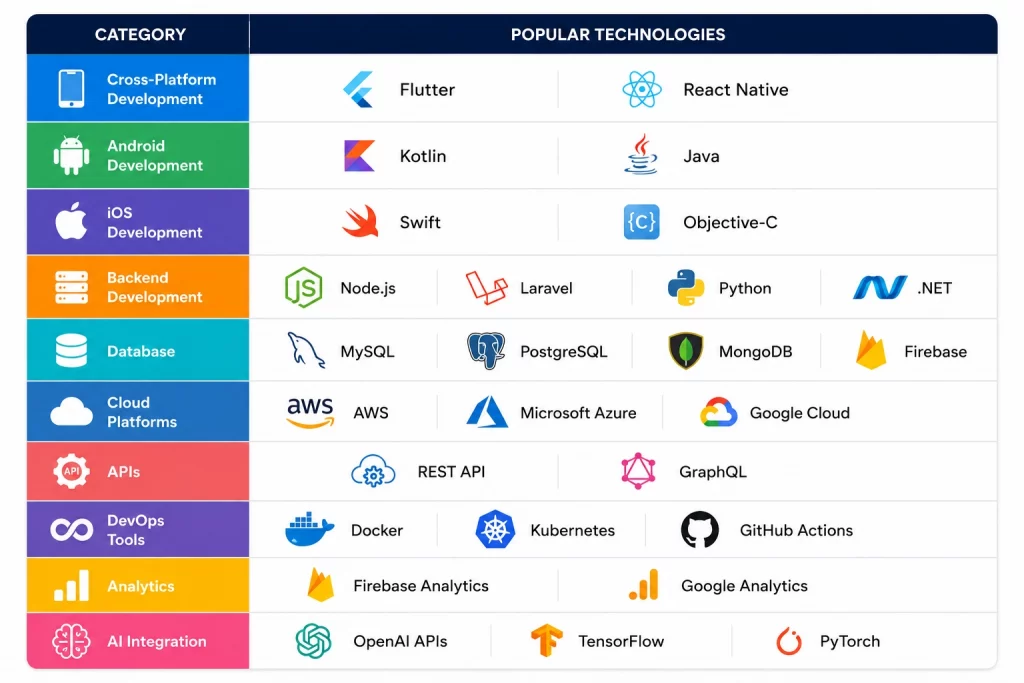
The ideal technology stack depends on your project’s complexity, target audience, budget, and long-term business goals.
Essential Features Every Successful Mobile App Should Have
While every application is unique, some features consistently improve user experience and business performance.
User-Friendly Interface
Simple navigation and intuitive design reduce friction and encourage users to continue using the app.
Fast Performance
Users expect apps to load quickly and respond instantly. Slow performance often leads to uninstallations and negative reviews.
Secure Authentication
Support secure login methods such as:
- Email authentication
- Social login
- OTP verification
- Biometric authentication
Security builds user trust and protects sensitive information.
Push Notifications
Personalized notifications help businesses:
- Increase engagement
- Promote offers
- Send reminders
- Improve customer retention
When used thoughtfully, push notifications can significantly increase user activity.
Offline Functionality
Allowing users to access essential features without an internet connection improves usability and customer satisfaction.
Analytics Integration
Built-in analytics help businesses understand:
- User behavior
- Retention rates
- Popular features
- Conversion rates
- App performance
These insights support data-driven decision-making and continuous improvement.
Third-Party Integrations
Many modern apps integrate with services such as:
- Payment gateways
- Maps
- CRM platforms
- Social media
- Chat systems
- Email marketing tools
These integrations enhance functionality and improve the overall user experience.
Expert Insight
A successful mobile app isn’t defined by the number of features it includes—it’s defined by how effectively those features solve real user problems. Prioritizing usability, performance, security, and scalability from the beginning creates a stronger foundation for long-term growth and higher customer satisfaction.
Industries That Benefit Most from Mobile App Development
Almost every industry can improve efficiency, customer engagement, and revenue with a well-designed mobile application. However, the features and objectives differ depending on the business model.
Healthcare
Healthcare organizations use mobile apps to simplify patient care and improve accessibility.
Common features include:
- Online appointment booking
- Video consultations
- Electronic health records
- Prescription reminders
- Health monitoring
- Secure patient communication
Business Benefit: Better patient engagement, reduced administrative work, and improved healthcare delivery.
E-commerce & Retail
Shopping apps have transformed the retail industry by providing customers with a seamless buying experience.
Popular features include:
- Product catalogs
- Secure payments
- Wishlist
- Order tracking
- Push notifications
- Personalized recommendations
Business Benefit: Higher conversion rates, increased customer retention, and greater lifetime customer value.
Education
Educational institutions and EdTech companies use mobile apps to make learning more interactive and accessible.
Features include:
- Live classes
- Video courses
- Online quizzes
- Assignment submission
- Progress tracking
- Certificates
Business Benefit: Improved student engagement and flexible learning experiences.
Finance & Banking
Financial apps require high levels of security while providing users with convenient access to banking services.
Typical features include:
- Fund transfers
- Investment tracking
- Digital wallets
- Expense management
- Biometric login
- Fraud detection
Business Benefit: Faster transactions, enhanced customer trust, and improved financial management.
Logistics & Transportation
Logistics companies use mobile apps to improve operational efficiency.
Features include:
- Real-time GPS tracking
- Delivery updates
- Route optimization
- Driver management
- Digital proof of delivery
- Fleet monitoring
Business Benefit: Reduced operational costs and improved customer satisfaction.
Real Estate
Property businesses use mobile applications to simplify property discovery and customer communication.
Common features:
- Property listings
- Virtual tours
- Mortgage calculators
- Agent chat
- Appointment booking
- Location-based search
Business Benefit: Faster lead generation and improved buyer experience.
Food Delivery & Restaurants
Restaurants and food delivery businesses depend heavily on mobile applications.
Essential features include:
- Digital menus
- Online ordering
- Table reservations
- Live delivery tracking
- Loyalty rewards
- Online payments
Business Benefit: Higher order volume and improved customer retention.
Why Businesses Prefer Professional Mobile App Development Services
Building an app involves much more than creating an attractive interface. Professional development companies help businesses avoid costly mistakes while delivering scalable, secure, and future-ready applications.
Access to Experienced Developers
Professional teams include:
- Business Analysts
- UI/UX Designers
- Android Developers
- iOS Developers
- Backend Developers
- QA Engineers
- DevOps Specialists
- Project Managers
Their combined expertise ensures every stage of development is handled efficiently.
Faster Time to Market
Experienced teams follow Agile development practices, allowing businesses to launch their applications faster while maintaining quality.
Better Security
Professional developers implement:
- Data encryption
- Secure authentication
- API protection
- Compliance standards
- Regular security testing
Security is especially critical for industries such as healthcare, finance, and eCommerce.
Scalability
Your app should support business growth without requiring a complete rebuild.
Professional developers design scalable architectures that accommodate:
- More users
- Additional features
- Increased traffic
- Third-party integrations
Long-Term Support
Technology evolves continuously.
Reliable development partners provide:
- App updates
- Bug fixes
- Security patches
- Performance optimization
- New feature development
This keeps your application competitive long after launch.
How Much Do Mobile App Development Services Cost?
Quick Answer: Mobile app development costs typically range from $5,000 to $150,000+, depending on the app’s complexity, platform, features, integrations, design requirements, and development team’s expertise.
There isn’t a fixed price because every application has unique business requirements.
Estimated Development Costs
| App Type | Estimated Cost |
|---|---|
| Basic App | $5,000 – $15,000 |
| Medium Complexity App | $15,000 – $50,000 |
| Advanced Business App | $50,000 – $100,000 |
| Enterprise Application | $100,000+ |
Note: These are general estimates. Actual costs vary based on project scope, technology stack, and development location.
Factors That Influence App Development Cost
1. App Complexity
The more features your application includes, the more development time it requires.
Examples of advanced features include:
- AI recommendations
- Real-time chat
- Video streaming
- GPS tracking
- Payment gateways
- Multi-language support
- Offline synchronization
2. Platform Selection
Developing separate native apps for Android and iOS generally costs more than building a cross-platform application using Flutter or React Native.
3. UI/UX Design
Custom animations, illustrations, interactive elements, and premium user experiences require additional design effort.
A better design often leads to higher engagement and stronger customer retention.
4. Third-Party Integrations
Integrating services such as:
- Payment gateways
- Maps
- CRM software
- ERP systems
- Analytics platforms
- Marketing automation tools
adds development complexity and cost.
5. Development Team Location
Development rates vary by region.
For example:
| Region | Typical Hourly Rate |
|---|---|
| North America | $100–$200 |
| Western Europe | $70–$150 |
| Eastern Europe | $40–$90 |
| India | $20–$60 |
Many businesses choose experienced Indian app development companies because they offer an excellent balance of quality and cost-effectiveness.
6. Post-Launch Maintenance
Maintenance typically accounts for 15–20% of the initial development cost per year and includes:
- Feature updates
- Bug fixes
- Security improvements
- Performance optimization
- Server monitoring
- Operating system compatibility updates
Planning for ongoing maintenance helps ensure your app continues performing well over time.
Questions to Ask Before Hiring a Mobile App Development Company
Before signing a contract, ask these important questions:
- Can you share similar projects you’ve completed?
- Which technologies do you recommend for my app?
- Who will own the source code after launch?
- What is the estimated timeline?
- How do you handle project communication?
- How many revisions are included?
- What security measures do you follow?
- Do you provide post-launch maintenance?
- How do you test the application?
- Can the app scale as my business grows?
The answers will help you compare development companies beyond pricing alone.
Common Mistakes Businesses Make When Hiring App Developers
Many businesses face delays and budget overruns because they overlook critical factors during the selection process.
Choosing Based Only on Price
The cheapest option often results in poor code quality, weak security, and expensive rework later.
Focus on value, expertise, and long-term partnership rather than the lowest quote.
Skipping the Discovery Phase
Rushing into development without defining business goals and user requirements frequently leads to scope changes and higher costs.
A thorough discovery process lays the foundation for project success.
Ignoring User Experience
Even the most feature-rich app can fail if it’s difficult to use.
Investing in intuitive UI/UX design improves customer satisfaction and increases user retention.
Overloading the First Version
Trying to include every possible feature in the initial release often delays launch and inflates costs.
Instead, prioritize core functionality, launch a Minimum Viable Product (MVP), gather user feedback, and enhance the app over time.
Neglecting Maintenance
Many businesses underestimate the importance of post-launch updates.
Without regular maintenance, apps can become incompatible with new operating system versions, vulnerable to security threats, and less appealing to users.
Thinking About Using AI to Build Your Mobile App?
AI-powered tools can help generate code and accelerate development, but they can’t replace strategic planning, UX design, security, testing, and ongoing maintenance.
Before relying solely on AI, read our in-depth guide:
Can AI Build a Mobile App? What You Should Know Before Trying.
Expert Checklist: How to Identify a Reliable Mobile App Development Company
Before making your final decision, ensure your development partner can confidently answer “Yes” to most of these questions:
✔ Proven portfolio of successful apps
✔ Positive client reviews and testimonials
✔ Experience in your industry
✔ Skilled Android and iOS developers
✔ Expertise in modern technologies
✔ Transparent pricing
✔ Agile development methodology
✔ Dedicated project manager
✔ Strong security practices
✔ Post-launch maintenance and support
✔ Clear communication process
✔ Scalable development approach
The more boxes a company checks, the greater the likelihood of a successful partnership.
Ready to Build Your Mobile App?
Have an app idea or planning to digitize your business?
At eWebWorld, we help startups, SMEs, and enterprises turn innovative ideas into powerful mobile applications that deliver exceptional user experiences and measurable business results.
Get in touch with our mobile app development experts today for a free consultation and discover how we can bring your vision to life.
Final Thoughts
A mobile application is no longer just an optional digital asset—it’s a strategic investment that can improve customer engagement, streamline operations, and create new revenue opportunities. However, the success of your application depends on choosing a reliable development partner with the expertise to transform your vision into a high-performing product.
By understanding the development process, evaluating technical capabilities, comparing technology options, and focusing on long-term support, you’ll be better equipped to make an informed decision that delivers lasting business value.
Whether you’re launching a startup, expanding an existing business, or digitally transforming your enterprise, investing in professional mobile app development services can give you a significant competitive advantage.
People Also Ask
1. What are mobile app development services?
Mobile app development services include planning, designing, developing, testing, launching, and maintaining mobile applications for Android, iOS, or cross-platform environments. These services help businesses create secure, scalable, and user-friendly applications that meet their goals.
2. How do I choose a reliable mobile app development company?
Look for a company with proven experience, a strong portfolio, positive client reviews, transparent pricing, modern technology expertise, and reliable post-launch support. Choosing a partner based on quality and long-term value is more beneficial than selecting the lowest-priced option.
3. How much does mobile app development cost?
The cost varies depending on app complexity, features, platforms, integrations, and design requirements. A basic application may cost between $5,000 and $15,000, while enterprise-level applications can exceed $100,000.
4. How long does it take to build a mobile app?
Development timelines depend on the project’s complexity.
- Basic Apps: 2–3 months
- Medium Complexity Apps: 3–6 months
- Enterprise Applications: 6–12 months or longer
Proper planning and Agile development help reduce delays.
5. Which is better: Native or Cross-Platform development?
Native development offers the best performance and user experience, making it ideal for complex applications. Cross-platform development is more cost-effective and allows businesses to launch on both Android and iOS faster using a single codebase.
6. Which technologies are commonly used for mobile app development?
Popular technologies include Flutter, React Native, Kotlin, Swift, Node.js, Laravel, Firebase, AWS, and Microsoft Azure. The ideal technology stack depends on your business goals and project requirements.
7. Why is UI/UX design important?
A well-designed user interface improves usability, customer satisfaction, and retention. An intuitive design encourages users to engage with your app and complete desired actions more efficiently.
8. Can startups benefit from custom mobile app development?
Yes. Many startups begin with a Minimum Viable Product (MVP) to validate their idea, gather user feedback, and expand features over time. This approach minimizes risk while accelerating time to market.
9. Do mobile apps require ongoing maintenance?
Yes. Regular maintenance includes bug fixes, security updates, performance improvements, operating system compatibility updates, and feature enhancements to ensure long-term success.
10. Why should I choose eWebWorld for my mobile app development project?
eWebWorld combines experienced developers, modern technologies, transparent communication, Agile development, and ongoing support to deliver scalable mobile applications that help businesses grow.

About The Author
Rishika Pawar is a Digital Marketing Specialist at eWebWorld with expertise in SEO, content strategy, and AI-first search optimization. She researches emerging technologies and collaborates with software engineers, UI/UX designers, and app developers to create comprehensive, research-backed content on mobile app development, web technologies, and digital transformation. Her work focuses on delivering accurate, user-first information that aligns with Google’s EEAT guidelines and modern AI search experiences.
Search
Popular Posts

Follow us

Recent Posts
About eWebWorld
eWebWorld is a Shopify and eCommerce development company in India with 10+ years of experience building and scaling online stores. We specialize in Shopify development, including store setup, customizations, theme development, migrations, integrations, and performance optimization. Through our expertise in eCommerce, technology, and digital marketing, we help businesses create better online experiences and achieve sustainable growth.