Shopify Plus for Growing Businesses: Everything You Need to Know
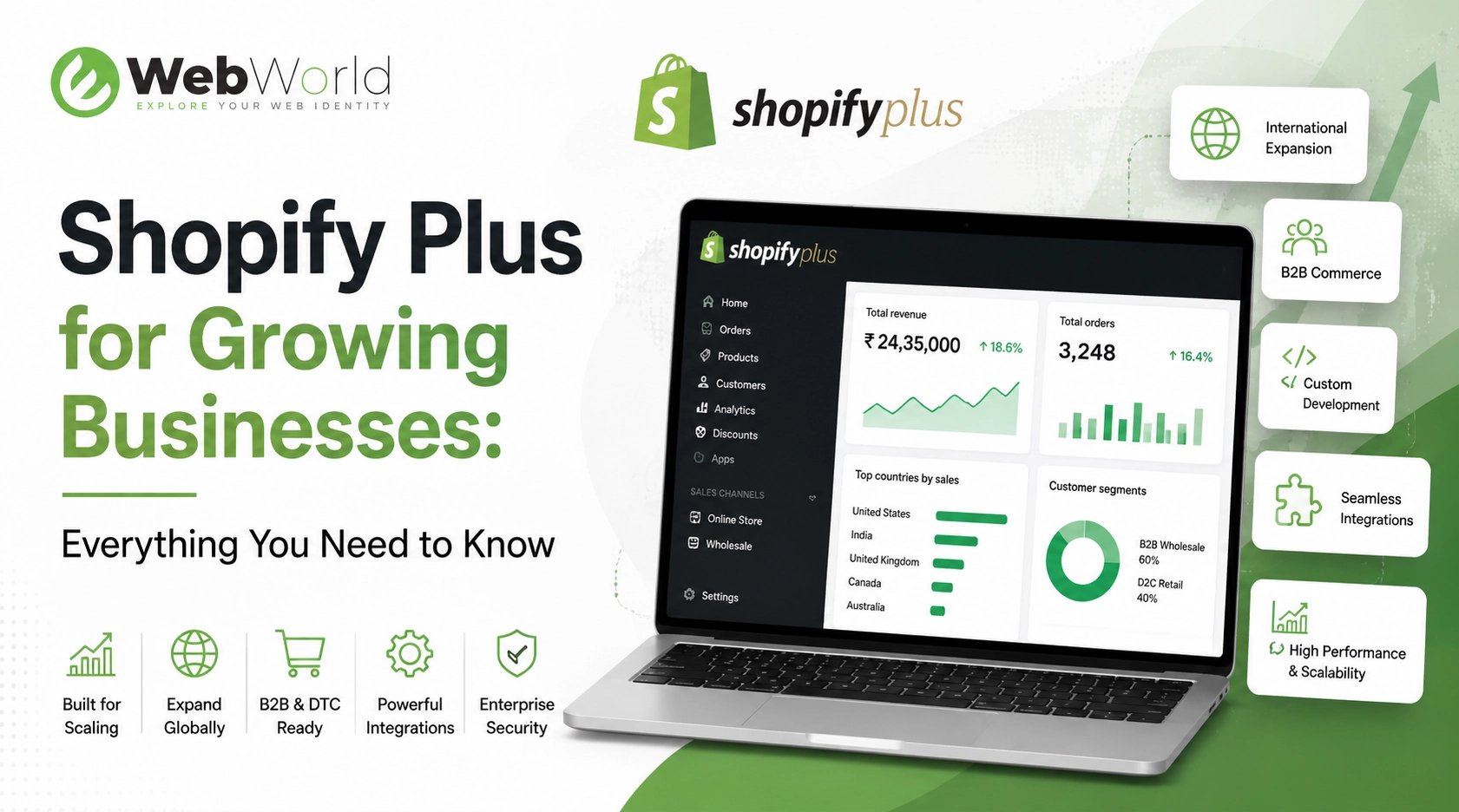
Ecommerce businesses rarely stay the same size for long. As a brand grows, its product catalog becomes larger, customer journeys become more complex, new markets are added, and integrations become increasingly important.
At some point, the challenge is no longer simply running an online store. Businesses need an ecommerce infrastructure that can support more sophisticated operations without slowing down growth.
This is where Shopify Plus comes into consideration.
Shopify Plus is Shopify’s enterprise-focused commerce offering for complex businesses, with capabilities designed around high-volume commerce, customization, B2B, international selling, omnichannel operations, and extensibility. Shopify currently lists Plus in India from ₹1,75,000 per month on a three-year term, while more complex businesses may have variable platform fees.
But Shopify Plus isn’t automatically the right choice for every growing business.
The real question is:
When does a business actually need Shopify Plus, and what does it gain by upgrading?
Let’s explore what growing businesses should know before making that decision.
What Is Shopify Plus?
Shopify Plus is Shopify’s offering for complex and high-growth businesses that need more advanced commerce capabilities than standard Shopify plans provide.
It includes the core Shopify commerce platform while adding capabilities around areas such as checkout customization, APIs, B2B commerce, international expansion, headless commerce, automation, and higher scalability.
Shopify highlights Plus capabilities including headless commerce, Shopify Functions, checkout customizations, B2B, Managed Markets, Shopify POS Pro, and higher API limits.
The important distinction is that Shopify Plus isn’t simply about getting a larger online store.
It’s about having more flexibility and control as your commerce operation becomes more complex.
Why Are Growing Businesses Considering Shopify Plus?
A small ecommerce store may only need:
- A storefront
- Product management
- Payments
- Basic apps
- Standard checkout
- Basic reporting
But as the business grows, additional requirements often appear.
For example:
- Multiple markets
- Multiple currencies
- B2B and DTC selling
- Complex pricing structures
- ERP integration
- CRM integration
- PIM integration
- Custom checkout requirements
- Advanced automation
- High-volume campaigns
- Multiple storefronts
- Custom business logic
- Headless commerce
At that point, businesses may need an ecommerce platform that can adapt to their operational requirements rather than requiring the business to work around platform limitations.
Shopify positions Plus specifically around complex businesses and highlights its ability to support online, retail, and B2B commerce from one platform.
Shopify vs. Shopify Plus: What's the Difference?
The difference isn’t simply “regular Shopify vs. enterprise Shopify.”
Standard Shopify plans already provide many capabilities required by growing businesses.
In fact, Shopify’s current plans include features such as unlimited products, multiple sales channels, SEO capabilities, analytics, and a full-featured online store.
Shopify Plus becomes more relevant when a business requires additional scale, customization, control, and operational flexibility.
| Area | Standard Shopify | Standard Shopify |
|---|---|---|
| Online store |  | |
| Unlimited products | | |
| Multiple sales channels | | |
| Standard checkout | | |
| B2B capabilities | Available on selected plans | More advanced capabilities |
| Checkout customization | More limited | Advanced customization |
| API capacity | Standard limits | Up to 500% higher API call limits |
| Custom Functions | Limited | Available |
| Expansion stores | Limited | Included capabilities |
| Headless commerce | Possible | Advanced enterprise use cases |
| International commerce | Available | Advanced global capabilities |
| High-volume commerce | Supported | Designed for complex/high-growth businesses |
Shopify’s current comparison also lists Plus-specific capabilities including higher API limits, expansion stores, custom Functions, custom user groups, and other enterprise features
Key Shopify Plus Features for Growing Businesses
1. Advanced Checkout Customization
Checkout is one of the most important parts of an ecommerce journey.
Shopify Plus provides additional opportunities to customize checkout experiences and extend checkout functionality according to business requirements.
This can be particularly valuable for businesses with:
- Complex purchasing workflows
- B2B requirements
- Custom promotions
- Specialized customer experiences
- Unique operational requirements
Shopify lists checkout customizations among the exclusive capabilities associated with Plus.
2. Higher API Capacity
Growing businesses often connect Shopify with multiple external systems.
These might include:
- ERP
- CRM
- PIM
- OMS
- Inventory systems
- Marketing platforms
- Analytics platforms
- Custom applications
Shopify’s current plan comparison lists up to 500% higher API call limits for Plus compared with standard plans.
This matters when a business has large catalogs, frequent synchronization, multiple integrations, or complex automated workflows.
3. Shopify Functions
Shopify Functions allow developers to extend Shopify’s backend logic to create customized commerce experiences.
For example, businesses can use custom logic for certain:
- Discounts
- Delivery options
- Payment methods
- Product and cart rules
Shopify identifies Functions as one of the capabilities available through Shopify Plus.
For businesses with unique requirements, this can reduce the need to force complex business rules into a collection of disconnected apps.
4. B2B Commerce
B2B is an important area for growing businesses selling to distributors, retailers, wholesalers, or corporate buyers.
Shopify has expanded native B2B functionality beyond Plus in 2026. Basic, Grow, and Advanced merchants can now access features such as company profiles, selected catalogs, volume pricing, and payment terms. However, more advanced capabilities—including unlimited catalogs and certain advanced payment functionality—remain exclusive to Plus.
Shopify Plus can therefore be particularly useful for businesses with more complex wholesale operations.
Potential requirements include:
- Multiple company locations
- Buyer permissions
- Customer-specific pricing
- Custom catalogs
- Payment terms
- Wholesale workflows
- Bulk purchasing
- B2B and DTC from one platform
5. International Expansion
International growth can introduce significant ecommerce complexity.
A business may need to manage:
- Different currencies
- Languages
- Regional pricing
- Localized content
- Market-specific catalogs
- International payments
- Cross-border selling
Shopify Plus includes international commerce capabilities through Shopify Markets and Managed Markets. Shopify says its Plus platform supports expansion into more than 150 countries.
For a business planning international expansion, this can make Shopify Plus worth evaluating as part of its broader commerce strategy.
6. Headless Commerce
Some growing businesses need more control over the frontend experience.
Headless commerce separates the customer-facing frontend from the commerce backend.
This can be useful when a business wants to create:
- Highly customized storefronts
- Content-rich experiences
- Custom shopping journeys
- Omnichannel experiences
- Commerce experiences across multiple interfaces
Shopify Plus supports headless commerce through Shopify APIs and its broader extensibility ecosystem.
However, headless isn’t automatically better. It introduces additional development and maintenance requirements, so businesses should use it when the business case justifies the added complexity.
Who Should Consider Shopify Plus?
Shopify Plus can make sense for businesses that are experiencing one or more of the following:
High transaction or order volumes
Businesses handling significant ecommerce activity may need infrastructure designed around scale and reliability.
Shopify states that its Plus checkout is load-tested for 10,000+ checkouts per minute, with unlimited bandwidth and transactions.
Multiple markets
Brands expanding across countries may benefit from more sophisticated international commerce capabilities.
B2B + DTC
Businesses selling both wholesale and directly to consumers may need more advanced B2B functionality.
Complex integrations
Businesses that depend heavily on ERP, CRM, PIM, OMS, or other systems may require greater extensibility.
Multiple storefronts
Businesses operating localized storefronts or expansion stores can benefit from Plus’s multi-store capabilities.
Complex customization
Brands with unique checkout, pricing, promotions, or business rules may need advanced customization.
Signs Your Business Has Outgrown Standard Shopify
Not every growing business needs Shopify Plus.
Here are some stronger indicators that it’s time to evaluate an upgrade.
1. Your integrations are becoming difficult to manage
If your store depends on multiple systems that constantly need to exchange data, API capacity and integration architecture become increasingly important.
2. You need advanced B2B functionality
If your wholesale operation requires sophisticated pricing, catalogs, permissions, payment terms, and buyer workflows, Plus may be worth considering.
3. You're expanding internationally
Multiple countries can introduce complexity around currencies, localization, products, pricing, and operations.
4. Your business requires advanced customization
If standard Shopify functionality can’t support an important business requirement, Shopify Plus’s additional extensibility may provide a better path.
5. Your current architecture is slowing growth
Technology debt can become expensive as a business scales.
If your team is constantly maintaining workarounds, disconnected apps, or custom systems simply to keep the store operating, it may be time to reassess the ecommerce architecture.
How Much Does Shopify Plus Cost?
Pricing is one of the biggest considerations before upgrading.
As of 2026, Shopify’s India pricing page lists Shopify Plus starting at ₹1,75,000 per month on a three-year term or ₹1,90,000 per month on a one-year term. Shopify also notes that more complex, higher-volume businesses may have a variable platform fee based on revenue and business structure.
That means businesses shouldn’t evaluate Plus purely by comparing subscription prices.
The better question is:
Will Shopify Plus create enough operational, technical, and commercial value to justify the investment?
Businesses should also consider costs associated with:
- Development
- Migration
- Custom integrations
- Apps
- Design
- Headless implementation
- Ongoing maintenance
- International expansion
Shopify itself notes that businesses requiring custom development should factor partner costs into their Plus budget.
Is Shopify Plus Worth It for a Growing Business?
It depends on the business.
If a business is still relatively simple and its current Shopify plan handles its requirements effectively, upgrading to Plus may not provide enough additional value.
But if the business is dealing with complex integrations, international expansion, advanced B2B requirements, high-volume commerce, multiple storefronts, or extensive customization, Shopify Plus can become a strategic investment rather than simply another ecommerce subscription.
The decision should be based on:
Business complexity + growth plans + technical requirements + expected ROI
—not revenue alone.
Why Shopify Plus Development Requires the Right Technical Approach
Moving to Shopify Plus doesn’t automatically solve an ecommerce business’s technical problems.
A poorly planned migration or implementation can still create:
- SEO issues
- Broken URLs
- Data inconsistencies
- Integration failures
- Poor performance
- Checkout problems
- Tracking gaps
- Customer experience issues
That’s why Shopify Plus projects should begin with architecture and requirements planning, rather than jumping straight into development.
A development partner can help businesses evaluate the existing technology stack, plan the migration, design the storefront, connect external systems, implement custom functionality, and support the post-launch environment.
Shopify itself highlights professional services for complex builds, including data migration and launch support, alongside its partner ecosystem.
How to Choose a Shopify Plus Development Partner
When evaluating a development agency, don’t look only at whether it can build a Shopify store.
Look for experience in areas relevant to your business:
- Shopify Plus development
- Store migration
- Custom theme development
- Shopify app development
- API integrations
- ERP/CRM/PIM integrations
- B2B commerce
- International ecommerce
- Performance optimization
- SEO migration
- Ongoing Shopify maintenance
Shopify’s Partner Directory allows merchants to evaluate partners based on factors such as services, experience, reviews, work samples, and partner tier.
Final Thoughts
Shopify Plus isn’t simply an upgraded version of Shopify with a higher price tag.
For the right business, it can provide a stronger foundation for scalable, customizable, international, B2B, and high-volume ecommerce.
But upgrading should be a strategic decision.
Before moving to Shopify Plus, businesses should evaluate their current platform, technical architecture, integrations, growth plans, international requirements, B2B needs, and expected return on investment.
The goal isn’t to choose the most powerful ecommerce platform. It’s to choose the platform that can support where your business is going next.
Frequently Asked Questions About Shopify App Integration
1. Is Shopify Plus only for large enterprises?
No. Shopify Plus is designed for complex and high-growth businesses, but company size alone shouldn’t determine whether a business needs it. Business complexity, technical requirements, transaction volume, expansion plans, and operational needs are better indicators.
2. What is the main advantage of Shopify Plus?
The major advantage is the additional scale, customization, extensibility, and enterprise-oriented capabilities available for complex commerce operations.
3. Can Shopify Plus support B2B and DTC?
Yes. Shopify Plus supports B2B and DTC commerce on the same platform, with advanced B2B capabilities available to Plus merchants
4. Can Shopify Plus support international stores?
Yes. Shopify Plus provides international commerce capabilities for businesses expanding into multiple markets.
5. Is Shopify Plus better than Shopify Advanced?
Not necessarily for every business. Advanced can be sufficient for many growing businesses. Plus becomes more relevant when a business needs capabilities and scale beyond what its current plan provides.
6. How much does Shopify Plus cost in India?
Shopify currently lists Plus from ₹1,75,000 per month on a three-year term in India, with a higher starting price for a one-year term. More complex businesses may have variable platform fees.

About The Author
Rishika Pawar is a Digital Marketing Specialist at eWebWorld with expertise in SEO, content strategy, and AI-first search optimization. She researches emerging technologies and collaborates with software engineers, UI/UX designers, and app developers to create comprehensive, research-backed content on mobile app development, web technologies, and digital transformation. Her work focuses on delivering accurate, user-first information that aligns with Google’s EEAT guidelines and modern AI search experiences.
Search
Popular Posts

Follow us

Recent Posts
About eWebWorld
eWebWorld is a Shopify and eCommerce development company in India with 10+ years of experience building and scaling online stores. We specialize in Shopify development, including store setup, customizations, theme development, migrations, integrations, and performance optimization. Through our expertise in eCommerce, technology, and digital marketing, we help businesses create better online experiences and achieve sustainable growth.