
Top 10 Use Cases of AI in Shopify Store Optimization in 2026
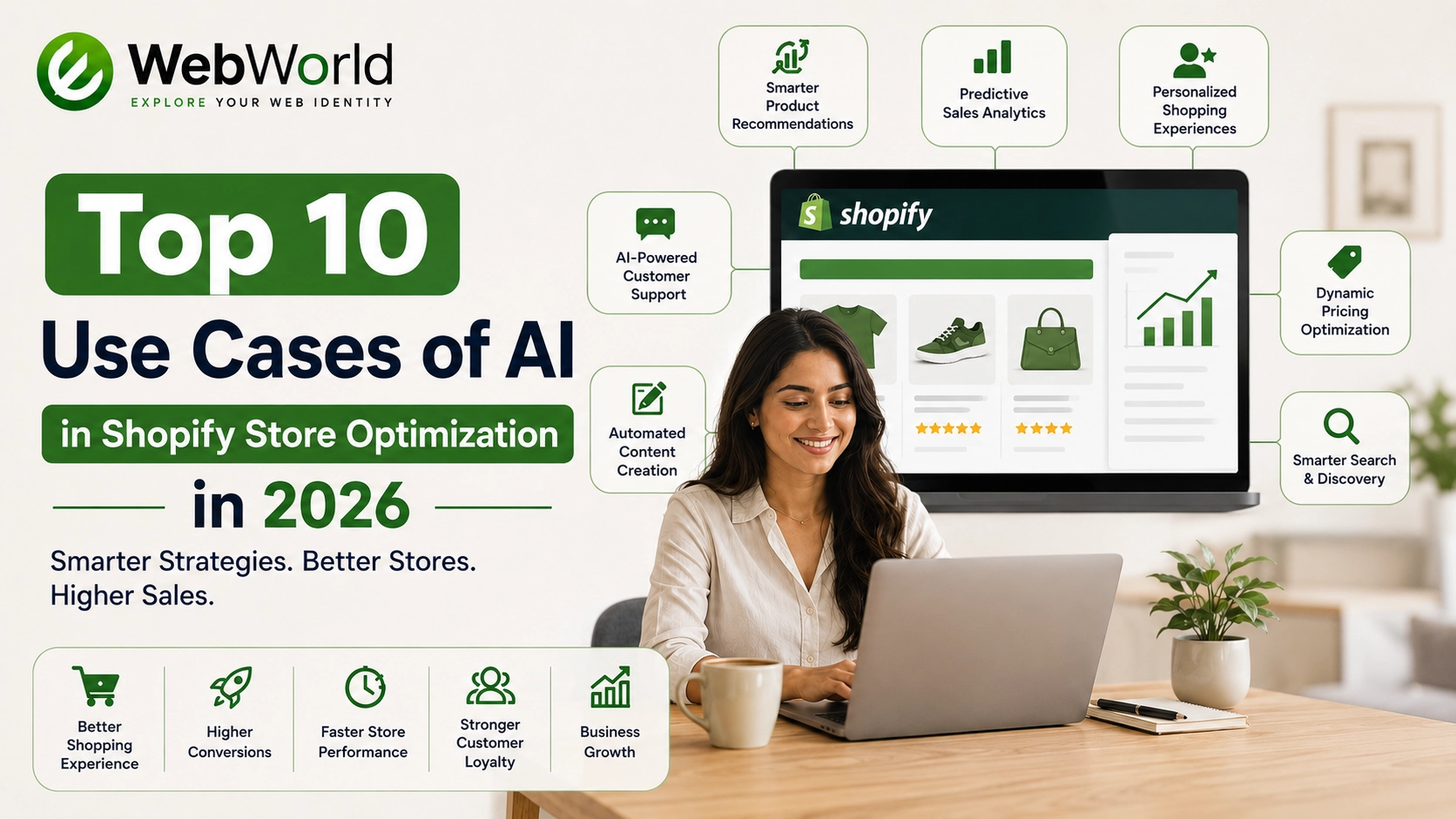
Running a Shopify store in 2026 is about much more than adding products and driving traffic. Customers expect fast experiences, relevant product suggestions, helpful answers, accurate information, and a smooth path from discovery to checkout.
This is where artificial intelligence (AI) is becoming increasingly useful.
AI can help Shopify merchants analyze store data, improve product content, personalize shopping experiences, identify SEO opportunities, automate repetitive tasks, and make better business decisions. Shopify itself has expanded AI capabilities through tools such as Shopify Magic and Sidekick, while AI-powered search and product discovery are becoming a bigger part of ecommerce.
But AI should not be treated as a button that automatically makes a store successful. The real value comes from using AI to solve specific problems and combining its recommendations with human judgment.
In this guide, we explore 10 practical use cases of AI for Shopify store optimization in 2026 and how each can help improve the customer experience, store performance, and potential conversions.
Why Is AI Important for Shopify Store Optimization?
A Shopify store can generate a large amount of data every day—from product views and searches to abandoned carts, customer behavior, sales, and traffic sources.
Analyzing all of this manually takes time.
AI can process large amounts of information much faster and help merchants identify patterns that may otherwise be missed. For example, AI can help identify products with high traffic but low conversions, suggest improvements to product content, analyze customer questions, or help create targeted customer segments.
Shopify’s Sidekick can already help merchants analyze data, manage products and orders, generate content, create customer segments, and perform other tasks using natural language.
The goal isn’t to replace the store owner. It’s to help the owner spend less time on repetitive work and more time making strategic decisions.
10 AI Use Cases for Shopify Store Optimization
1. AI-Powered Product Description Optimization
Product descriptions influence both user experience and product discoverability. Many Shopify stores have hundreds or even thousands of products. Writing and updating unique descriptions for every product manually can be difficult, especially when product information changes frequently. AI can help merchants:
- Create first drafts of product descriptions
- Make descriptions easier to scan
- Highlight product benefits
- Improve readability
- Adapt content to different customer segments
- Identify missing product information
- Create consistent descriptions across product collections
Shopify Magic can generate product descriptions based on information such as the product title and keywords. However, Shopify recommends reviewing AI-generated content because it can introduce inaccurate claims or information that was not originally provided. The important part Don’t simply generate a description and publish it. Add real product details, specifications, use cases, materials, dimensions, compatibility information, and anything else a customer would genuinely want to know. AI should create the starting point—not the final answer.
2. Personalized Product Recommendations
Imagine a customer visits your Shopify store looking for running shoes.
Instead of showing the same products to everyone, AI can help determine which products are more relevant based on browsing behavior, previous interactions, product relationships, and other available signals.
AI-powered recommendations can be used for:
- “You may also like”
- “Frequently bought together”
- Related products
- Recently viewed products
- Cross-sell recommendations
- Upsell opportunities
- Personalized collections
Shopify’s Search & Discovery tools already support product recommendations alongside search and filtering capabilities.
For example, someone viewing a laptop could see:
Laptop → Laptop Bag → Wireless Mouse → USB-C Hub
This makes it easier for customers to discover useful products while increasing opportunities for additional purchases.
Best practice
Don’t recommend products simply because they have high margins.
Recommendations should make sense from the customer’s perspective.
3. AI-Powered Shopify Search Optimization
Site search is often overlooked.
A customer who uses your search bar usually has a strong buying intention. If your search system cannot understand what they mean, you may lose the sale.
AI can make store search more useful by understanding:
- Different ways customers describe a product
- Misspellings
- Related terms
- Product attributes
- Natural-language queries
- Search intent
Shopify’s storefront search already includes AI-powered infrastructure, including predictive search and typo tolerance.
For example, a customer might search:
“black waterproof jacket for winter”
Instead of relying only on an exact keyword match, a smarter search experience can understand the meaning behind the query and surface relevant products.
How to optimize it
Review your internal search data regularly.
Look for:
- Popular searches
- Searches with no results
- Searches producing irrelevant products
- Common spelling mistakes
- Queries leading to conversions
These insights can reveal gaps in your product catalog and site navigation.
4. AI for Shopify SEO
SEO remains important, but optimizing a large ecommerce store manually can become repetitive.
AI can assist with several Shopify SEO tasks, including:
- Meta title suggestions
- Meta description drafts
- Product content optimization
- Content gap analysis
- Internal linking opportunities
- Search intent analysis
- Keyword clustering
- Category-page content ideas
- Identifying thin or repetitive content
AI can also help analyze which products or pages receive impressions but generate relatively few clicks.
For example:
A product page receives 1,500 impressions but only 12 clicks.
That doesn’t automatically mean the page is bad. It could indicate an opportunity to improve the title, meta description, product positioning, or search relevance.
Don’t rely on AI for keyword stuffing
Search engines increasingly focus on helpful, useful content rather than pages created simply to target keywords.
Use AI to identify opportunities, but make sure the final content genuinely answers customer questions and reflects the actual product.
5. AI-Based Customer Support
Customers don’t always want to wait for an email response.
They may have simple questions such as:
- Where is my order?
- What is your return policy?
- Is this product available?
- Which size should I choose?
- Do you ship internationally?
- How long does delivery take?
AI-powered chat assistants can handle many repetitive questions instantly.
This can reduce the workload on support teams while giving customers quicker access to information.
Where AI support works best
Use AI for questions with clear answers based on your store’s policies and product information.
For complex issues—such as refunds, complaints, damaged products, or unusual orders—give customers an easy way to reach a human.
The best support strategy isn’t AI instead of humans. It’s AI for routine questions and humans for situations that require judgment.
6. AI for Customer Segmentation
Not every customer behaves the same way.
A first-time visitor has different needs from a repeat customer who has purchased five times.
AI can help identify customer groups based on available behavioral and purchase data, such as:
- First-time buyers
- Repeat customers
- High-value customers
- Customers who haven’t purchased recently
- Frequent browsers who don’t purchase
- Customers interested in specific categories
- Customers who abandoned their carts
Shopify’s Sidekick can assist with creating customer segments using natural-language instructions.
For example, instead of manually creating a complicated filter, a merchant could ask for a segment such as:
“Show me customers who purchased skincare products in the last six months but haven’t purchased in the last 60 days.”
That segment could then be used for a targeted campaign.
7. AI for Conversion Rate Optimization
Getting visitors to your Shopify store is only half the job.
The bigger question is:
Why aren’t more visitors buying?
AI can help analyze patterns across your store and identify potential conversion problems.
For example, it may highlight:
- Products with high traffic but low sales
- Pages with high bounce or exit rates
- Checkout drop-off points
- Frequently abandoned products
- Poor-performing landing pages
- Weak product descriptions
- Missing trust signals
- Frequently asked questions that aren’t answered
Suppose one product receives thousands of visits but very few purchases.
Instead of immediately spending more money on advertising, investigate the page first.
Could the issue be:
- Price?
- Product images?
- Shipping information?
- Reviews?
- Product specifications?
- Page speed?
- Lack of trust?
- Confusing CTA?
AI can help identify patterns, but you still need to test changes before assuming they will improve conversions.
8. AI for Inventory and Demand Forecasting
Inventory problems can hurt both revenue and customer satisfaction.
Too much inventory can tie up cash.
Too little inventory can lead to stockouts and missed sales.
AI can analyze historical sales and other available data to help merchants identify demand patterns and make better inventory decisions.
9. AI-Generated Marketing Content and Campaigns
Creating marketing content for an ecommerce business can become a full-time job.
You may need:
- Email campaigns
- Promotional copy
- Social media content
- Product announcements
- Blog content
- Ad variations
- Seasonal campaigns
- Customer messages
AI can help create initial versions of this content much faster.
Shopify’s Sidekick supports content generation for areas such as blog posts, marketing materials, email campaigns, images, and other store tasks.
But there is a major difference between generating content and creating effective marketing.
A generic AI message like:
“Don’t miss our amazing collection. Shop now!”
is unlikely to stand out.
A better approach is to give AI real information about:
- The customer
- The product
- The problem being solved
- The offer
- The brand voice
- The reason to buy now
Then edit the output so it sounds like your business—not an AI tool.
10. AI for AI Search and Agentic Commerce
This is one of the most important areas for Shopify merchants to watch in 2026.
Customers are increasingly using AI-powered interfaces to discover information and products. Shopify has been investing heavily in AI, including technologies for search, discovery, and AI agents.
This creates a new question for ecommerce businesses:
Can AI systems understand and recommend your products?
Your product data becomes increasingly important.
AI systems need clear information about:
- Product names
- Product descriptions
- Features
- Specifications
- Prices
- Availability
- Variants
- Shipping
- Return policies
- Brand information
Poor or incomplete product information can make it harder for both customers and AI systems to understand what you’re selling.
What Shopify merchants should do
Start by improving the fundamentals:
- Keep product information accurate.
- Use clear product titles.
- Provide detailed specifications.
- Maintain consistent product attributes.
- Answer common customer questions.
- Keep pricing and availability updated.
- Build trustworthy brand mentions and content.
- Make your product catalog easy to understand.
AI search optimization isn’t simply about adding more keywords.
It’s about making your store’s information clear, accurate, useful, and easy for machines and humans to understand.
AI Doesn't Replace Shopify Optimization—It Changes How You Do It
AI can make Shopify optimization faster, but it doesn’t eliminate the need for good ecommerce fundamentals.
A slow website will still be slow.
A confusing checkout will still frustrate customers.
Poor product photography will still hurt the buying experience.
Weak product information will still create uncertainty.
AI works best when it is built on a strong foundation.
Think of AI as an optimization assistant, not a magic solution.
Use it to find problems faster, understand customers better, automate repetitive work, and make more informed decisions.
Final Thoughts
The biggest opportunity with AI in Shopify isn’t simply generating content faster.
It’s using AI to make better decisions across the entire customer journey.
From product descriptions and site search to personalization, SEO, customer support, inventory forecasting, conversion optimization, and AI-powered product discovery, there are now more opportunities for Shopify merchants to use AI than ever before.
The stores that benefit most won’t necessarily be the ones using the most AI tools.
They’ll be the ones using the right AI tools to solve the right problems.
If you’re optimizing a Shopify store in 2026, start small, measure the results, verify AI-generated information, and gradually expand the workflows that genuinely improve the customer experience and business performance.
AI can help your Shopify store work smarter—but the strategy behind it still matters most.
People Also Ask
1. How can AI help optimize a Shopify store?
AI can help optimize a Shopify store by improving product descriptions, personalizing product recommendations, analyzing customer behavior, improving site search, supporting SEO, automating customer support, and identifying conversion opportunities.
2. How can a Shopify development company help with AI optimization?
A Shopify development team can help identify suitable AI use cases, integrate AI-powered tools, connect data sources, customize store functionality, improve performance, and test whether AI-driven changes actually improve the customer experience and business results.
3. Can AI help Shopify stores provide 24/7 customer support?
AI-powered chat assistants can answer common questions at any time, such as questions about products, shipping, returns, and order information. Complex complaints, refunds, or unusual situations should still be handled by a human support team.
4. How can AI improve product recommendations on Shopify?
AI can analyze signals such as product interactions, browsing behavior, purchase patterns, and product relationships to suggest products that are more relevant to each shopper. This can support cross-selling and upselling.

About The Author
Akshita Dubey is an SEO Executive at eWebWorld with expertise in search intent analysis and content optimization. She focuses on creating user-centric content that simplifies complex technology topics, helping businesses and decision-makers understand web development, mobile apps, and digital solutions through clear, research-based insights.
Search
Popular Posts

Follow us

Recent Posts



About eWebWorld
eWebWorld is a Shopify and eCommerce development company in India with 10+ years of experience building and scaling online stores. We specialize in Shopify development, including store setup, customizations, theme development, migrations, integrations, and performance optimization. Through our expertise in eCommerce, technology, and digital marketing, we help businesses create better online experiences and achieve sustainable growth.