
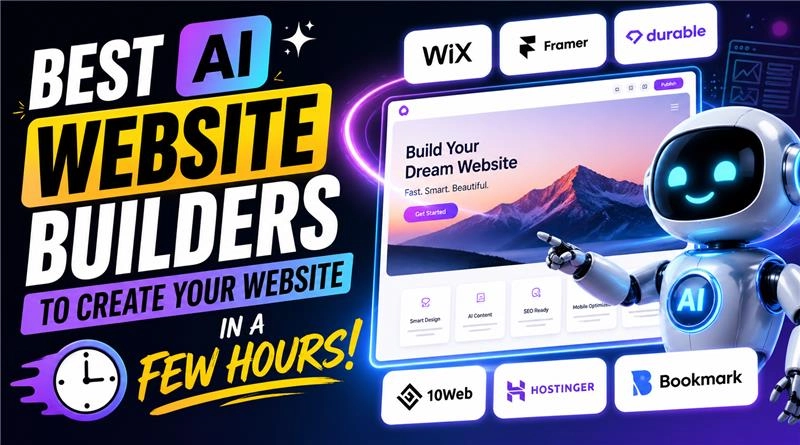
Best AI Website Builders to Create Your Website in a Few Hours
Building a website once required a significant investment of time, resources, and coordination. The process went from planning and design to development and revisions; which could take weeks or even months before a site was ready to go live.
Today, that process is evolving rapidly. With the rise of AI website builders, it’s now possible to generate layouts, create content, and launch a basic website within a matter of hours. Tasks that previously required a full team can now be initiated with just a few inputs, making website creation more accessible than ever.
However, this shift also raises an important question.
How far can these tools actually take you? While speed and convenience are clear advantages, it’s worth understanding if AI-generated websites can truly match the quality, flexibility, and performance of traditionally built websites.
In this blog, we’ll explore some of the best AI website builders available in 2026, how they work, and what you can realistically expect when using them.
What is an AI Website Builder?
An AI website builder is a platform that uses artificial intelligence to create websites with minimal manual effort. Instead of designing and developing each element from scratch, users can input basic information such as their business type, goals, or preferences, and the tool automatically generates a website layout, content, and structure.
When you build with AI, these tools typically handle tasks like designing page sections, suggesting layouts, writing placeholder content, and organizing navigation. Some also offer features like automated SEO suggestions, image generation, and basic performance optimization.
Why people are using AI website builders
- Faster website creation: launch basic websites in hours instead of weeks
- No technical skills required: beginner-friendly and easy to use
- Cost-effective: reduces the need for large teams or high upfront investment
- Quick starting point: useful for MVPs, landing pages, or testing ideas
- Easy to update and iterate: make changes without complex processes
Can You Really Build a Website in a Few Hours?
The short answer is yes, but only to a certain extent. With AI website builders, you can generate a basic website within a few hours. Layouts, sections, and even content can be created quickly, allowing you to go from idea to a live site much faster than traditional methods.
However, speed doesn’t always equal completeness.
While you build with AI, these tools are great for getting started, building a fully functional, high-performing website often requires more than just quick generation. Elements like user experience, performance optimization, scalability, and customization still need careful planning and refinement.
What you can realistically achieve in a few hours
- A basic website with essential pages
- Simple layouts and structure
- AI-generated placeholder content
- A quick launch for testing or early-stage use
Where it starts to fall short
- Limited customization and flexibility
- Generic design and user experience
- Lack of advanced functionality
- Performance and scalability concerns
Top AI Website Builders to Try in 2026
AI website builders are evolving fast, with different tools focusing on different parts of the process like design, structure, content, or full-site generation. Here are some of the most popular options you can explore.
| Tool | Best For | Ease of Use | Customization | Speed | Pricing (Approx) |
|---|---|---|---|---|---|
| Wix AI | Beginners & small businesses | High | Medium | Fast | Starting at $17–$159/mo |
| Hostinger AI | Budget-friendly websites | High | Low-Medium | Fast | $6.99-$79.99/mo |
| Relume | Wireframes & site structure | High | Medium | Fast | Free & Paid, $26/mo |
| v0 by Vercel | UI generation (dev-focused) | Medium | High | Fast | Free & Paid, $30-$100/mo |
| Framer AI | Design + live websites | High | High | Fast | $10-$100/mo |
| Lovable | Simple AI site generation | High | Low | Fast | Free & Paid, $25-50/mo |
| Orchids | Experimental AI builds | Medium | Medium | Fast | Free & Paid, $21-$169/mo |
| Tempo Labs | Rapid prototyping | Medium | Medium | Fast | Free & Paid, $30/mo |
| Atlas AI | Structured website generation | Medium | Medium | Fast | $39-$119/mo |
| Wegic | Chat-based website creation | High | Low | Fast | $2.99-$41.99/mo |
A Closer Look at These AI Website Builders
1. Wix AI
Who it’s for: Beginners, small businesses, and non-technical users
What we like: Guided setup, quick website generation, all-in-one platform
Pricing: Free plan available, paid plans start from ~$17/month
Wix AI is one of the most accessible AI website builders available today, designed specifically for users who want to create a website quickly without dealing with design complexity or technical setup.
Instead of starting from a blank canvas, users answer a few guided questions about their business, goals, and preferences. Based on this input, Wix AI generates a complete website structure, including layouts, sections, and even initial content.
What makes Wix AI stand out is how it simplifies decision-making. It removes the need to think about design systems, spacing, or structure; everything is prearranged in a way that works reasonably well out of the box. For someone launching their first website or testing an idea, this can significantly reduce the time and effort required to go live.
However, this simplicity comes with trade-offs. While the generated websites are functional and visually acceptable, they often lack uniqueness and deeper customization.
As requirements grow, like if it’s advanced features, performance optimization, or brand-specific design, the limitations of a template-driven system start to show.
Key Benefits:
- Quick website generation with minimal input
- Guided setup removes decision fatigue
- Ideal for beginners and non-technical users
- All-in-one platform (design, hosting, deployment)
2. Hostinger AI Website Builder
Who it’s for: Individuals, startups, and small businesses on a budget
What we like: Affordable pricing, fast setup, simple interface
Pricing: Paid plans start from ~$6.99 – $79.99/mo
Hostinger’s AI website builder focuses on speed, affordability, and simplicity, making it a strong option for individuals and small businesses looking to establish an online presence without a large upfront investment.
The platform uses AI to generate a basic website based on user input, including layout suggestions, content, and structure. One of its biggest advantages is how quickly you can move from an idea to a live website.
The interface is straightforward, and the AI handles much of the initial setup, allowing users to create a functional site within a short time frame. For budget-conscious users, it offers a practical way to get started without hiring a full team.
That said, Hostinger AI is best suited for simpler use cases. While it performs well for basic websites, landing pages, or small business sites, it doesn’t offer the same level of flexibility or scalability as more advanced tools or custom development approaches. As the website grows in complexity, users may find themselves limited by the platform’s capabilities.
Key Benefits:
- Cost-effective solution for quick website creation
- Fast setup and deployment
- Built-in AI tools for content and structure
- Suitable for small businesses and simple websites
3. Relume
Who it’s for: Designers, agencies, and teams working on website structure and UX
What we like: Fast wireframing, structured layouts, component-based design system
Pricing: Free plan available, paid plans start from ~$26/month
Relume is not a traditional website builder, it’s more of a website planning and structuring tool powered by AI. Instead of generating a full website ready to publish, Relume helps you quickly create wireframes, sitemaps, and layout structures that can later be turned into fully functional websites.
What makes Relume particularly useful is how it speeds up the early stages of a project. Instead of starting from scratch, you can generate structured page layouts and reusable components within minutes. This is especially valuable for teams working on platforms like Webflow or React, where having a clear structure upfront significantly reduces development time.
However, Relume isn’t meant to be a complete solution. It doesn’t handle full deployment or advanced functionality on its own. It works best as part of a larger workflow, where planning and structure need to be done quickly but execution still requires design and development effort.
Key Benefits:
- Rapid wireframing and layout generation
- Strong focus on structure and UX
- Reusable components for faster workflows
- Speeds up the planning phase significantly
4. v0 By Vercel
Who it’s for: Developers and teams building modern web interfaces
What we like: Clean UI generation, code-friendly output, fast component creation
Pricing: Free plan available, paid usage may vary
v0 is a developer-focused AI tool that generates user interfaces and frontend components using natural language prompts. Instead of relying on drag-and-drop builders, it produces structured, code-ready outputs that can be directly integrated into development workflows.
Its biggest strength lies in how it bridges the gap between design and development. Teams can quickly generate UI components, experiment with layouts, and accelerate frontend work without manually building everything from scratch. For developers working with modern frameworks, this can significantly reduce repetitive work.
That said, v0 is not designed for beginners or non-technical users. It requires a basic understanding of development to fully utilize its capabilities. It also doesn’t handle full website creation or deployment, making it more of a productivity tool for developers rather than a complete website builder.
Key Benefits:
- Generates clean, usable UI components
- Speeds up frontend development
- Works well with modern development stacks
- Reduces repetitive coding tasks
5. Framer AI
Who it’s for: Designers, startups, and teams building modern, visually rich websites
What we like: Strong design control, smooth animations, and instant publishing
Pricing: Paid plans start from ~$10-$100/month
Framer AI is designed for users who want a balance between AI-generated speed and high-quality design output. It allows you to generate a website using simple prompts, but unlike many basic AI builders, it gives you much more control over layout, spacing, typography, and interactions.
What makes Framer AI stand out is its design-first approach. The output doesn’t just feel functional, it feels polished. It’s especially popular among startups and product teams that want to launch landing pages quickly without compromising on visual quality or user experience.
At the same time, Framer still expects a certain level of design awareness. While AI helps you get started quickly, refining the final product often requires manual adjustments to get things exactly right.
Key Benefits:
- High-quality, modern design output
- Fast from idea to live website
- Strong customization for layouts and animations
- Great for landing pages and startup websites
6. Lovable
Who it’s for: Beginners, solo founders, and users who want ultra-simple website creation
What we like: Extremely easy to use, fast generation, minimal setup
Pricing: Free plan available, paid plans from $25/month
Lovable focuses on simplicity above everything else. It’s built for users who don’t want to deal with design decisions, structure planning, or technical setup. You simply describe what you want, and the tool generates a basic website for you.
Its biggest strength is speed and accessibility. Even someone with zero technical or design experience can get a working website up in a very short time. This makes it useful for early-stage ideas, personal projects, or simple landing pages.
However, this simplicity also means limited flexibility. Customization options are minimal, and while the output is functional, it may not always meet the needs of more complex or brand-specific projects.
Key Benefits:
- Extremely fast website generation
- Very beginner-friendly interface
- Minimal input required from the user
- Great for simple websites and quick ideas
7. Orchids
Who it’s for: Developers, founders, and teams building full-stack apps (web, mobile, and backend systems)
What we like: Converts plain English into full-stack applications, supports backend, database, and authentication, and can generate production-ready systems quickly
Pricing: Free plans available, paid plans from Free & Paid, $21/month
Orchids is an AI-powered app and website builder designed to go beyond simple web pages. Unlike traditional AI website builders that focus mainly on layouts and front-end design, Orchids is built to generate complete applications, including front-end interfaces, back-end logic, databases, authentication systems, and deployment-ready code.
The platform works by taking a natural language description of what you want to build and converting it into a structured, functional application. This makes it particularly useful for startups and teams that want to move from idea to a working product without spending months on initial development setup.
What makes Orchids different is its focus on full-stack output rather than just visual website creation. It’s not just about designing pages; it’s about building systems that actually function, store data, and support real user interactions.
However, because of its depth, it can feel more technical compared to simpler AI website builders. It is better suited for users who want production-level outputs rather than quick landing pages.
Key Benefits:
- Generates full-stack applications (frontend + backend + database)
- Converts plain English into working product structures
- Useful for MVPs, SaaS products, and complex apps
- Supports continuous iteration and deployment workflows
8. Tempo Labs
Who it’s for: Designers, developers, and product teams working with React-based applications
What we like: Visual + code hybrid workflow, AI-assisted UI generation, strong collaboration between design and development
Pricing: Free plan available, paid plans start from ~$30/month
Tempo Labs is a visual AI development platform focused on speeding up React application development. It bridges the gap between design tools and code editors by allowing users to visually build, edit, and refine UI components while simultaneously generating production-ready React code.
Instead of working purely through prompts or purely through code, Tempo Labs offers a hybrid workflow where users can drag, modify, and interact with components while the AI handles code generation and structure in the background. This makes it especially useful for teams that want faster UI iteration without sacrificing code quality.
One of its strongest advantages is how it integrates directly into real development workflows. It supports importing existing React projects and works well with modern frontend stacks, making it more suitable for serious product development rather than simple website creation.
However, because it is React-focused and more developer-oriented, it may not be ideal for beginners or users looking for quick no-code website builders.
Key Benefits:
- Speeds up React UI and component development
- Combines visual editing with real code output
- Ideal for product teams and developers
- Supports existing codebases and iterative workflows
9. Atlas AI
Who it’s for: E-commerce brands, Shopify store owners, and D2C businesses looking to quickly build high-converting online stores
What we like: AI-generated product pages, conversion-focused layouts, built-in upsells and bundles, Shopify integration, strong focus on sales optimization
Pricing: Paid plans typically start around $39-$119/month
Atlas AI is not a traditional website builder, it is more of an AI-powered e-commerce store builder designed specifically for conversion-focused online businesses. Instead of just generating layouts, it focuses on building entire sales-driven pages such as product pages, homepages, and landing pages that are optimized for conversions.
What makes Atlas AI different is its strong focus on e-commerce psychology and structure. The tool is built around tested store patterns like upsells, bundles, and persuasive product storytelling. This means the output is not just visually structured but also strategically designed to improve sales performance.
It is particularly useful for businesses that want to quickly launch or test product ideas without spending weeks building a store manually. However, because it is highly optimized for e-commerce use cases, it is less suitable for general websites or highly custom brand experiences.
Key Benefits:
- Builds full Shopify-based stores quickly using AI
- Conversion-focused layouts (upsells, bundles, sales flow)
- Strong for D2C and product-based businesses
- Speeds up product page and store setup significantly
10. Wegic
Who it’s for: Beginners, founders, and non-technical users who want a simple way to build websites through conversation
What we like: Chat-based website creation, very low learning curve, fast generation, simple workflows
Pricing: Paid plans typically start around $2.99-$41.99/month
Wegic takes a very different approach compared to most AI website builders. Instead of selecting templates or manually editing layouts, users simply describe what they want in a chat interface, and the system generates a complete website based on those instructions.
This makes it one of the most beginner-friendly AI website builders available. The entire process feels more like talking to a designer rather than building a website, which significantly reduces friction for first-time users or non-technical founders.
However, this simplicity also comes with limitations. While Wegic is excellent for quick website creation and basic use cases, it offers limited control over deep customization, advanced functionality, or highly specific design requirements.
Key Benefits:
- Fully chat-based website creation experience
- Extremely fast for basic website generation
- No technical or design knowledge required
- Ideal for MVPs, landing pages, and quick launches
What’s Behind These AI Website Builders?
At first glance, AI website builders may seem like standalone tools that generate websites instantly. But in reality, most of them rely on a combination of underlying systems working together to handle different parts of the process.
It goes from generating layouts and writing content to structuring pages and suggesting design elements. These tools are powered by systems that can interpret inputs, make decisions, and produce outputs quickly.
This is where the concept of AI agents comes in. AI agents are designed to handle specific tasks within a workflow. Instead of doing everything manually, these systems assist in breaking down complex processes, like website creation into smaller, manageable steps and executing them efficiently.
Example of an AI Agent in Website Development
To make this easier to understand, think of an AI agent as a digital assistant handling specific parts of the website creation process.
For example, you input basic details about your business, like your industry, target audience, and goals. An AI agent can then:
- generate a homepage layout
- suggest sections like “Services” or “Testimonials”
- create initial content for each section
- organize the overall structure of the site
Instead of doing each of these steps manually, the agent handles them in the background, helping you move from idea to a working draft much faster.
How AI Agents Help in Website Development
AI agents play a key role in speeding up different parts of the website creation process. While they may not replace the need for strategy or expertise, they significantly reduce the time spent on repetitive and manual tasks.
Here’s where they make the biggest impact:
- Faster layout and structure generation: Quickly creates page sections and overall site architecture
- Content and copy assistance: Helps generate headings, descriptions, and basic messaging
- Improved user flow suggestions: Recommends how pages and sections should be structured
- Reduced manual effort: Automates repetitive tasks in design and development
- Faster iterations and updates: Makes it easier to test, refine, and improve quickly
How eWebWorld Uses AI to Build Faster, Smarter Websites
At eWebWorld, we don’t see AI as a replacement for development; we see it as a way to make the entire process faster, more efficient, and more structured.
Instead of relying only on traditional workflows, we combine AI tools and intelligent systems with real development expertise. This allows us to speed up key parts of the process while still focusing on quality, performance, and long-term scalability.
AI helps us move faster but the thinking, planning, and execution still remain intentional.
Where AI helps us the most
- Smarter planning and structure: AI assists in organizing content and page flow based on proven patterns
- Faster mockups and initial concepts: We can quickly generate layouts and ideas, reducing the time spent in early-stage design
- Reduced development timelines: Repetitive and time-consuming tasks are streamlined, allowing us to build more efficiently
- Quicker iterations and improvements: We can test, refine, and update faster without slowing down the process
- Better focus on performance: With less time spent on manual work, we focus more on what actually matters, user experience and results
Reality Check: Can AI Really Do It All?
AI has made website creation faster and more accessible than ever before. From generating layouts to writing content, it can handle a significant portion of the process in a fraction of the time it used to take.
But it’s important to understand what AI can and cannot do. While AI tools and agents are great for speeding things up, they don’t replace the need for thoughtful planning, strategic thinking, and real-world execution. A website that simply looks complete isn’t always one that performs well.
Things like user experience, brand alignment, scalability, and long-term performance still require a deeper level of understanding that goes beyond automation. AI can accelerate the process, but it doesn’t replace the thinking behind it.
Final Thoughts
AI website builders have clearly changed how websites are created. What once required weeks of planning, design, and development can now begin with just a few inputs and be brought to life in a matter of hours. That shift is real and it’s only accelerating.
For individuals, small businesses, and early-stage ideas, this opens up new possibilities. You can test concepts faster, launch quicker, and reduce the initial effort required to get online. In many ways, AI has lowered the barrier to entry for building a website. But building a website and building something that actually works are two very different things.
As expectations grow, whether it’s performance, scalability, user experience, or brand identity, the limitations of quick, AI-generated solutions start to become more visible. What works as a starting point doesn’t always hold up as a long-term solution. That’s where the real shift is happening.
It’s no longer about choosing between AI or traditional development. The real advantage comes from how AI is used within a structured, thoughtful process. When combined with the right expertise, AI becomes a powerful tool, not just for speed, but for building better outcomes.
The future of web development isn’t just faster; it’s smarter. And for businesses looking to grow, that difference matters.
People Also Ask
1. What is the difference between an AI website builder and an AI agent?
- An AI website builder creates complete websites by generating layouts, content, and structure based on user input.
- An AI agent, however, handles specific tasks like content generation, optimization, or user experience improvements within the website-building process.
2. How do AI agents improve website user experience?
AI agents improve user experience by analyzing user behavior and optimizing content, layout, and navigation. They can personalize content, suggest better page structures, and continuously refine the website to make it more intuitive and engaging.
3. How much does it cost to implement an AI agent on a standard website?
Basic AI tools can cost as little as $10–$50 per month. More advanced implementations, such as custom AI workflows or integrations, can cost more depending on complexity and development requirements.
4. What will be the role of web developers in an AI-agent-led web ecosystem?
Web developers will focus more on strategy, system design, and integrating AI tools. While AI handles repetitive tasks, developers ensure performance and scalability and build custom functionality that AI alone cannot deliver.
5. What are the top security risks of using autonomous AI agents on a website?
Key risks include data privacy issues, incorrect outputs, over-reliance on automation, and integration vulnerabilities. These can be managed with proper security practices, trusted tools, and regular human oversight.

About The Author
Nidhi writes content at eWebWorld and has a knack for making tech talk sound human. With 3+ years of experience in content creation, she’s all about cool web trends, clean UI, and turning geeky stuff into scroll-worthy reads. When she’s not writing about web development or UI/UX trends, she’s probably diving into creative inspiration like exploring new tools or sketching ideas for her next blog.
Search
Popular Posts





Follow us

Recent Posts
About eWebWorld
eWebWorld is a Shopify and eCommerce development company in India with 10+ years of experience building and scaling online stores. We specialize in Shopify development, including store setup, customizations, theme development, migrations, integrations, and performance optimization. Through our expertise in eCommerce, technology, and digital marketing, we help businesses create better online experiences and achieve sustainable growth.